

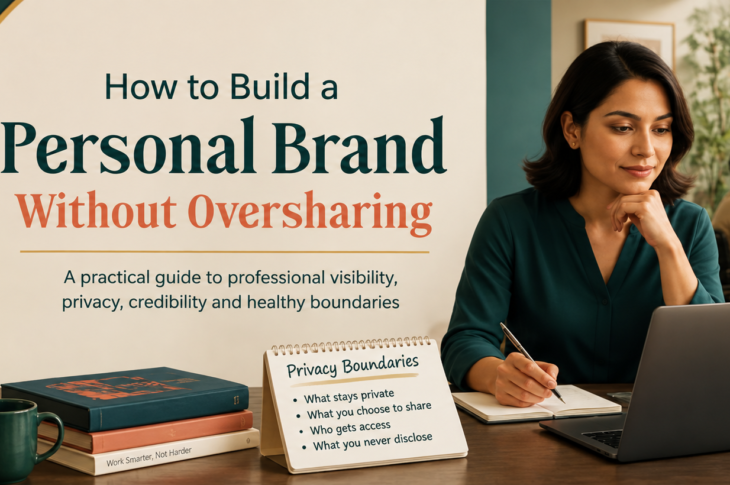
Visibility without giving away your private life
A woman is preparing a LinkedIn post, portfolio update, or professional introduction. She wants to be visible for better opportunities, but every piece of advice seems to say: share everything, post constantly, reveal your struggles, and turn every life experience into content. She pauses and wonders: how can I become memorable without making my private life public?
That question matters whether you are changing careers, returning to work, building a business, or simply trying to be understood more clearly. How can you communicate professional value and build trust while keeping healthy boundaries around your identity, family, relationships, health, finances, location, beliefs, and personal experiences?
Personal branding is not personal exposure—visibility with a boundary
Personal branding is the professional impression created by your skills, work, communication, values, reliability, and areas of expertise. Personal exposure is revealing private information, emotional history, family details, location, health information, finances, relationship details, or sensitive identity information to gain attention.
|
Personal brand |
Personal exposure |
|
Useful work, thoughtful ideas, clear standards, and respectful relationships |
Private details shared to satisfy pressure, curiosity, or an audience |
|
Can be built through a portfolio, résumé, referrals, presentations, or reliable work |
Can include family information, private images, medical details, or sensitive experiences |
Authenticity does not require complete transparency. You can be genuine, warm, and relatable while choosing not to disclose personal details. A personal brand is not a performance of perfection, a popularity contest, or a requirement to become an influencer. It cannot guarantee a promotion, client, job, recognition, or income.
Think of it as a consistent professional signal: the work you do, the problems you solve, the topics you understand, the way you communicate, and the values you demonstrate. No one owes the internet constant access to their personality or private story.
What a strong professional brand actually communicates
A strong brand helps the right people understand what you contribute and what you want to do next. It may appear in a portfolio, résumé, professional profile, presentation, community contribution, thoughtful article, referral, mentoring relationship, case study, talk, class, or dependable day-to-day work.
It can also reflect different cultures, languages, class backgrounds, disabilities, ages, family structures, gender identities, sexual orientations, faiths, privacy preferences, and employment circumstances. A polished, extroverted, highly personal style is only one style—not a requirement for credibility.
The oversharing trap: when visibility becomes vulnerability
Sharing a difficult experience can be meaningful when you choose it, understand the audience, and feel comfortable with the long-term record. But trauma, illness, grief, family conflict, financial stress, relationship problems, and discrimination should never become required career content.
Before posting, ask:
- Would I still be comfortable with this being searchable in five years?
- Does this reveal someone else’s private information?
- Am I sharing because it supports my professional point, or because I feel pressured to prove authenticity?
- Could this affect my safety, employment, housing, relationships, or wellbeing?
You can edit a personal story into a principle or professional observation. “I learned to document decisions clearly during a difficult project” is safer and more useful than publishing confidential details about colleagues or clients.
Find your professional through-line
Your through-line is the idea connecting your skills, interests, experience, and direction. Explore it with these questions:
- What problems do I help solve?
- Who benefits from my work?
- What subjects or skills do people already ask me about?
- What kind of work do I want more of?
- What do I want people to remember after interacting with my work?
- Which values can I demonstrate through my decisions and process?
- What evidence supports my claims: work samples, outcomes, responsibilities, lessons, feedback, or projects?
Try one of these honest positioning formulas:
“I help [audience or team] with [problem or work] so they can [useful outcome].”
Or: “I’m a [role or learner] focused on [area], with experience in [evidence or context].”
Early in a career, you can say: “I’m exploring [field] by building [projects, skills, or contributions].”
Choose three content boundaries before you post
Use a three-layer sharing model. You decide what belongs in each layer, and those choices can change over time.
- Public professional layer: skills, portfolio work, general lessons, public projects, industry observations, helpful resources, and professional goals.
- Selective context layer: a career transition, learning challenge, or personal perspective shared with details removed and only when useful.
- Private layer: family, home location, financial information, medical information, legal matters, intimate relationships, children’s details, private images, confidential workplace information, and anything shared by another person in confidence.
Share lessons without publishing private details
Before turning an experience into content, remove names, dates, screenshots, locations, and identifying details. Ask whether the lesson serves the audience or simply proves that you have suffered enough to be authentic. You are allowed to keep the story private and share only the professional insight.
Build credibility through evidence, not constant posting
Credibility grows when people can see how you think and follow through. Consider these options:
- Keep a simple portfolio of selected work, explaining the problem, your role, process, decisions, and outcome without breaching confidentiality.
- Answer real questions with short posts or notes instead of posting only to stay active.
- Share context with resources by explaining why an article, tool, or book matters.
- Document a project lesson without naming clients or exposing internal data.
- Request specific feedback or recommendations that reflect real collaboration.
- Contribute where you can through professional communities, panels, workshops, mentoring, open-source projects, local groups, or internal knowledge-sharing spaces.
Consistency means clarity and reliability, not daily posting. A person with a strong portfolio and thoughtful relationships may be building more trust than someone producing constant updates.
A simple content and profile system
Keep the system small enough to use:
- One expertise theme: what you know or are learning.
- One audience: who benefits from the information.
- One format: a short post, case study, portfolio note, presentation, newsletter, video, workshop, or conversation.
- Three content pillars: teach something, show how you work, and reflect on a professional lesson.
Choose a rhythm based on your capacity, such as one useful post or portfolio update every week or two. That is an example, not a universal rule. After a month, notice which conversations, opportunities, and work samples feel aligned rather than chasing vanity metrics.
Privacy, safety, and workplace boundaries
Review profile visibility, contact details, location tags, photos, old posts, public calendars, connections, and direct-message settings. Avoid real-time travel updates, your home address, children’s school details, financial information, private documents, passwords, access codes, and identifiable routines.
Remove client names, confidential figures, internal screenshots, and proprietary information unless you are authorised to share them. Check employer policies, professional-body rules, client contracts, intellectual property obligations, confidentiality duties, and other legal or professional requirements before publishing. Deleting a post may not remove screenshots or copies.
Separate professional and personal accounts only when that genuinely improves boundaries; separation is not a guarantee of privacy. Be cautious with unsolicited offers, free-work requests, investment pitches, recruitment scams, and invitations to move conversations off-platform.
If harassment or doxxing occurs, preserve evidence, block or report where appropriate, and seek relevant workplace, platform, legal, or local support. Do not confront someone in a way that could put you at greater risk.
Different careers need different visibility strategies
A designer might use a portfolio. A teacher can share lesson principles without student information. A healthcare professional may need strict confidentiality. A researcher can discuss public findings, while a public servant or regulated professional may face additional restrictions. A freelancer can share process and outcomes when authorised.
Disabled professionals may discuss accessibility expertise, request accommodations, or keep health information private. Disclosure is optional. Introverts, caregivers, people with limited time, people in unsafe environments, and people from underrepresented groups may prefer writing, referrals, asynchronous communities, or low-visibility credibility building. Your brand should not require expensive equipment, constant video, a polished home, unpaid labour, or personal availability.
What to do when you have little experience or no audience
You do not need a large audience to begin. Create two or three honest sample projects, document your process, and label them as practice or self-initiated work. Learning, volunteering, caregiving-related skills, community work, internships, freelance assignments, courses, and experiments can be evidence when you describe them accurately. Name your actual experience and learning edge instead of exaggerating expertise.
Common mistakes and better alternatives
|
Mistake |
Better alternative |
|
Posting every day to stay visible |
Publish less often with a clear purpose |
|
Copying a loud influencer voice |
Use language that sounds natural and credible to you |
|
Turning every hardship into content |
Share a chosen lesson only when it serves the audience |
|
Sharing confidential work to prove credibility |
Anonymise examples or create a fictionalised demonstration |
|
Confusing engagement with trust |
Prioritise useful work, quality conversations, and follow-through |
|
Accepting unpaid requests for exposure |
Clarify scope, credit, compensation, and fit |
|
Treating criticism as a demand to reveal more |
Revise what is useful and protect what is private |
Do / Don’t guidance for healthier visibility
- Don’t make private disclosure the price of visibility. Do show your skills, thinking, and work.
- Don’t publish in real time when safety could be affected. Do use delay, general locations, and careful settings.
- Don’t share confidential information to make a story impressive. Do anonymise, generalise, or ask permission.
- Don’t build a brand around perfection. Do communicate what you know, are learning, and value.
- Don’t measure success only through likes or followers. Do notice aligned conversations, referrals, work samples, and opportunities.
- Don’t let one platform define you. Do keep a portfolio and relationships beyond one feed.
What to do when personal branding feels complicated
- No idea what to post? Answer one real work question, explain one process, or share one resource with context.
- Posts feel too personal? Remove identifying details, rewrite the lesson generally, or keep the story private.
- No portfolio? Make two or three honest practice projects and document the process.
- Engagement is low? Review relevance and clarity, but do not assume few likes mean little professional value.
- Someone asks for too much access? Say, “I’m happy to discuss the professional topic, but I keep personal details private.”
- An employer or client objects? Pause publication, review the policy or agreement, and seek qualified workplace or legal guidance where needed.
- Branding feels exhausting? Reduce platforms, choose one format, batch updates, or focus on direct relationships and a strong portfolio.
A 7-day personal-brand reset
This is a privacy-conscious clarity exercise, not a popularity challenge.
- Day 1: Write your professional through-line—who you help, what you do, and what you want to be known for.
- Day 2: Review your public profile and remove or update one outdated or unnecessary detail.
- Day 3: Create three sharing boundaries: what is public, selective, and private.
- Day 4: Choose one expertise theme and write a short useful note without personal disclosure.
- Day 5: Select one work sample or project lesson and describe the problem, process, and result honestly.
- Day 6: Check employer, client, professional-body, and platform rules before publishing.
- Day 7: Choose one sustainable next step: update your profile, publish the note, ask for feedback, join a community, or create another work sample.
Five small actions to start today
- Write one sentence describing the work or problems you want to be associated with.
- Remove one unnecessary personal detail from a public professional profile.
- Save three examples of your work, learning, or contribution as evidence.
- Draft one helpful professional post that reveals no private or confidential information.
- Decide how you will respond when someone asks for more personal access than you want to give.
Mini checklist
- Can people understand what I do or what I am learning?
- Does my profile reflect the opportunities I want next?
- Am I sharing professional value rather than private exposure?
- Have I checked confidentiality, employer, and professional obligations?
- Have I removed real-time location, financial, family, or safety-sensitive details?
- Can I support my claims with work samples, responsibilities, or lessons?
- Is my tone natural rather than copied from an influencer?
- Is my rhythm sustainable for my time and energy?
- Do I have a boundary for personal questions, free work, and unsolicited access?
- Would I still stand by this public record in a few years?
A professional brand can leave room for a private life
Building a personal brand does not require becoming publicly available. You can be memorable through clear work, useful ideas, thoughtful communication, consistent standards, and respectful relationships. You can share selectively, change your mind, keep parts of your life private, and grow visibility at a pace that fits your safety, career, and values.
The goal is not to make every part of yourself marketable. It is to make the professional value you choose to share easier for the right people to recognise.
