







In this article, we will take a deep dive into the concept of a mother’s “Mental Load”. We explore why mothers often find themselves as the unofficial “Project Managers” of the household and discuss practical ways to share this burden with the entire family.
1. The 9 PM Panic
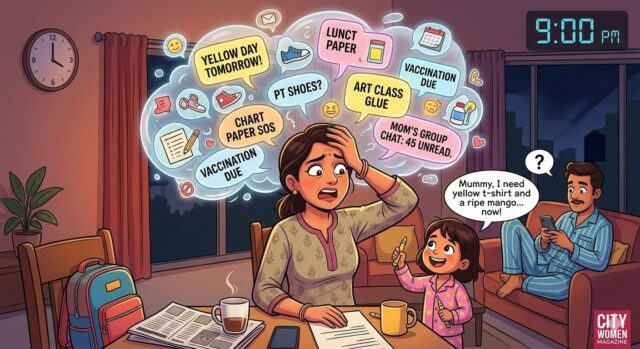
Imagine it is 9:00 PM. A mother has finished all the kitchen chores, prepared the next day’s tiffin, and finally sits on the sofa for five minutes of peace. Suddenly, her child runs in from the bedroom and says, “Mummy, tomorrow is ‘Yellow Day’ at school… I need to wear a yellow t-shirt and bring a yellow fruit!”.
This is where the “9 PM Panic” begins. Her brain’s “hard drive” immediately starts scanning: Is there a yellow t-shirt at home? Is it washed and clean? If not, will the nearby shop still be open? Is there a mango or a banana in the fridge?. For the next hour, she transforms into a detective, a tailor, and a manager. But have you ever wondered why the responsibility of knowing it is “Yellow Day” fell solely on her shoulders?.
2. ‘Mental Load’: The Invisible Labor
Household chores are often limited to cooking, laundry, or cleaning. However, there is another invisible task called the “Mental Load”. In Indian society, a mother doesn’t just do the work; she is the household’s “Project Manager”. She is the one who remembers:
- That children must wear white uniforms on Saturdays.
- When the younger one’s next vaccine dose is due.
- Whether the children’s PT shoes are clean or not.
- Which of the 50 messages on the school WhatsApp group are actually important.
- To check WhatsApp notifications before sleeping and immediately upon waking up.
- What needs to be prepared for breakfast and lunch tiffins for everyone.
While a father might help by dropping the kids at school, the mother holds the entire “data” regarding what is inside the bag and what should be there. This constant planning is mentally exhausting.
3. The Pressure of the “Strong and Versatile” Woman
Recently, City Women Magazine discussed the terms “Strong Woman” and “Versatile (Sarvagun Sampann) Woman”. Are these words compliments or hidden pressures? In Indian culture, the definition of a “good mother” is someone who knows every tiny detail about the house.
If a child forgets something at school, society often views it as “mother’s negligence” rather than the child’s mistake. Due to this social pressure, mothers turn their brains into “living calendars”. They fear that if they don’t remember, their child will fall behind. This quest for perfection is the root cause of the 9 PM Panic.
4. WhatsApp Groups: A Blessing or a Burden?
Today, every class has its own WhatsApp group. In theory, this should make things easier, but in reality, it is an endless flood of information. Messages starting with “Dear Parents” often arrive late in the evening or at night.
Since mothers are usually the primary contacts in these groups, all the data lands directly in their minds. This digital “noise” prevents them from sleeping peacefully, as they feel compelled to check their phones constantly for new instructions.
How to Share the Burden with the Family?
How to Exit ‘CEO’ Mode?
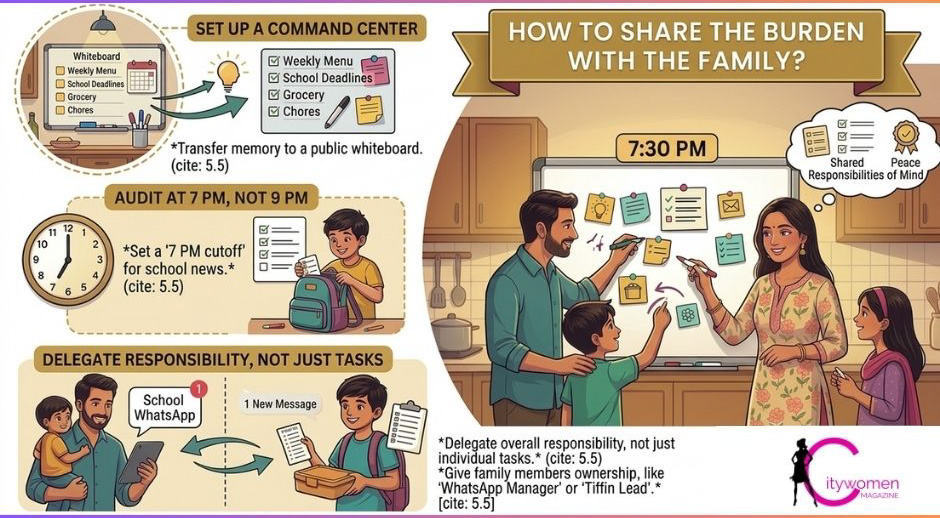
The only way to escape this mental exhaustion is by sharing responsibilities. The home must be run as a team rather than a “one-woman show”. Here are some practical suggestions:
- The Whiteboard: Instead of keeping all the data in your head, shift it to a wall in the house. Put a whiteboard in the kitchen listing the weekly school schedule, grocery lists, and important dates. Make it a rule: if someone needs something, they must write it on the board. This makes information public and clears the mother’s mind.
- 7 PM Prep for the Next Day: Establish a rule to prepare for the next day at 7:00 PM instead of 9:00 PM. Shoes, dresses, and stationery should all be checked by then. If it isn’t mentioned by 7 PM, there will be no late-night scramble. This also instills a sense of responsibility in children.
- WhatsApp Partnership: Why should only the mother’s number be in school groups?. Fathers should also be actively involved. One week the mother and the next week the father can take on the role of “Group Manager”.
- Raising Independent Children: Sometimes the 9 PM Panic happens because we provide too much “service” to our kids. Children over 10 can pack their own bags and check their uniforms. Let them face the consequences of small mistakes, like forgetting PT shoes once. Once they are held accountable at school, they will start remembering their own things. A mother’s role should be the “backup,” not the “main server”.
It is vital to realize that you are a human being, not a super-computer. Forgetting “Yellow Day” or a chart paper once or twice does not define your worth as a mother. City Women Magazine has always encouraged women to connect with themselves and explore practices like “nature therapy”.
The 9 PM Panic is a symptom of a system where the entire load rests on one shoulder. Shed this burden. Talk to your partner, make your children responsible, and most importantly—drink that 9 PM cup of tea in peace. A “Strong Woman” is not one who does everything alone, but one who knows when to say “no” and when to ask for help.