




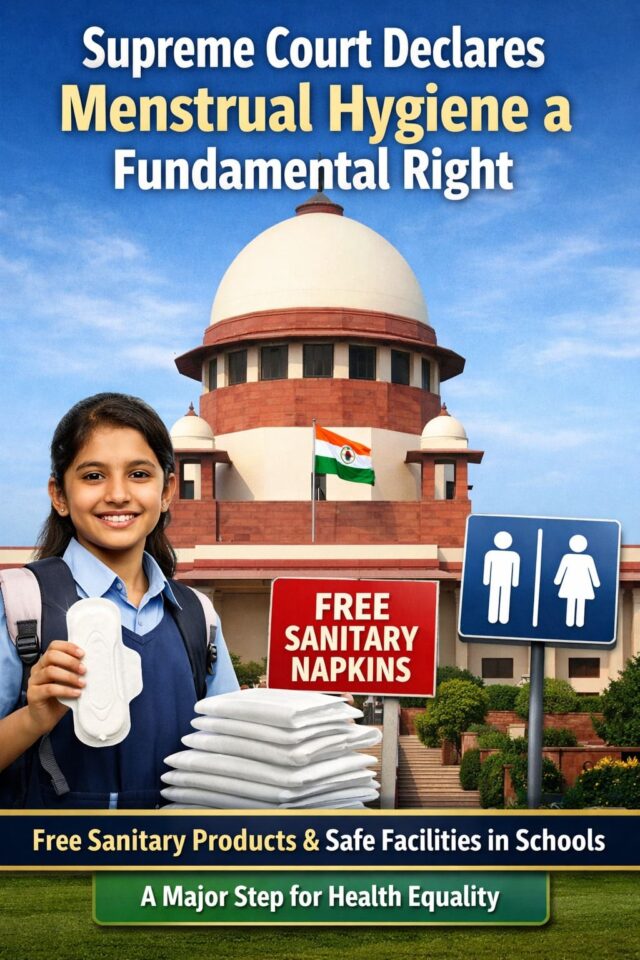
On January 30, 2026, the Supreme Court of India delivered a historic judgment recognizing access to menstrual hygiene as a fundamental right under Article 21 of the Constitution — the Right to Life and Dignity. This landmark ruling mandates that all states and Union Territories provide free, biodegradable sanitary pads to schoolgirls from Classes 6 to 12, marking a transformative step toward gender equality, health, and education.
Understanding the Supreme Court’s Ruling
The verdict, delivered in response to a Public Interest Litigation (PIL) filed by Dr. Jaya Thakur, addresses the long-standing issue of menstrual poverty and its impact on girls’ education and dignity. The Court emphasized that menstrual health is not merely a matter of hygiene but a constitutional right linked to dignity, health, and education.
Key Highlights of the Judgment
- Fundamental Right to Menstrual Hygiene
The Court declared that menstrual health is an essential component of the Right to Life under Article 21. It recognized that lack of access to menstrual products and facilities directly affects girls’ dignity, health, and educational opportunities. - Free and Sustainable Sanitary Products
All state governments and Union Territories are now required to provide free sanitary pads to schoolgirls in Classes 6–12. The Court specifically directed the use of biodegradable and eco-friendly products to ensure environmental sustainability. - Improved School Infrastructure
Every school, including private institutions, must have functional, gender-segregated toilets equipped with water, soap, and proper disposal mechanisms for menstrual waste. This move aims to create a safe and hygienic environment for girls. - Comprehensive Menstrual Education
The Court instructed the National Council of Educational Research and Training (NCERT) and State Councils of Educational Research and Training (SCERT) to integrate gender-sensitive, age-appropriate menstrual health education into school curricula. This includes lessons on puberty, hygiene, and breaking social taboos surrounding menstruation. - Implementation and Accountability
The Supreme Court directed the central and state governments to formulate a national policy on menstrual hygiene management. Authorities must submit compliance reports within three months, ensuring timely and transparent implementation.
Why This Verdict Matters
This ruling is a monumental step toward ending menstrual poverty — a condition where girls and women lack access to safe and affordable menstrual products. According to various studies, thousands of girls in India miss school during their periods due to inadequate facilities and social stigma. By recognizing menstrual hygiene as a fundamental right, the Court has paved the way for inclusive education, gender equality, and improved public health.
Impact on Education and Society
- Reduced Dropout Rates: Access to menstrual products and proper sanitation will help reduce absenteeism and dropout rates among adolescent girls.
- Breaking the Stigma: Incorporating menstrual education into school curricula will normalize conversations around menstruation, fostering awareness and empathy.
- Empowering Future Generations: The judgment empowers young girls to manage their health with dignity, confidence, and knowledge.
Toward a More Equitable Future
The Supreme Court’s decision is not just a legal milestone but a social revolution. It acknowledges that menstrual health is central to achieving gender justice and human rights. By mandating free access to sanitary products, better infrastructure, and education, the Court has set a precedent for other nations to follow.
As India moves forward, effective implementation, community awareness, and sustainable practices will be key to ensuring that no girl’s education or dignity is compromised because of menstruation.