

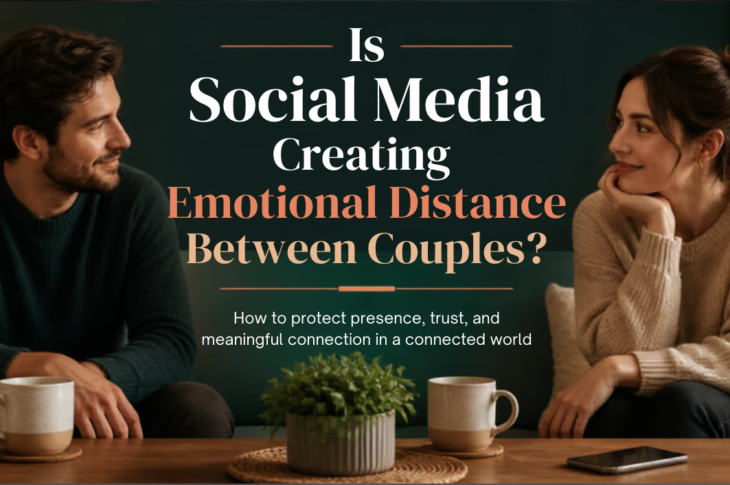
When the person beside you feels miles away 📱
Have you ever looked up from your phone and realised that an entire evening has passed without a real conversation? Or tried to share something important, only to watch your partner glance at a notification before saying, “Sorry, what were you saying?” These moments can feel small, but repeated distractions may slowly make a relationship feel less emotionally close.
Social media is not automatically harmful to love. It can help couples stay connected across distance, share encouragement during a busy day, and feel included in each other’s worlds. The more useful question is not whether a couple uses social media, but how their habits, expectations, and boundaries shape the time they spend together.
|
The heart of the issue: Social media may create distance when it consistently replaces attention, direct communication, curiosity, or quality time. The platform is only part of the story; the relationship patterns around it matter just as much. |
How social media can create emotional distance
Constant scrolling can quietly divide a shared moment. One partner may be physically present but mentally absorbed in a stream of posts, messages, and short videos. Over time, the other person may stop bringing up thoughts, worries, or small daily stories because they expect only half an answer.
Phone distraction during conversations can have a similar effect. A delayed response may be innocent, but repeated interruptions can communicate, unintentionally, that online activity deserves immediate attention while the relationship can wait. Digital messages also leave room for misunderstandings: a short reply, a missed message, or a delayed response may be read as anger or disinterest when the real explanation is simply a busy day.
Some couples use social media to avoid difficult conversations. Posting a vague message, sharing a pointed quote, or becoming unusually active online can feel easier than saying, “I am hurt.” Yet indirect communication rarely gives both people enough context to repair the issue.
Signs your digital habits may be affecting the relationship
No single sign proves that social media is damaging a relationship. Still, these patterns may be worth noticing with curiosity rather than blame:
- Feeling ignored while together — One or both partners regularly scroll during meals, conversations, or shared activities.
- Reassurance through checking — You feel pulled to monitor a partner’s activity, likes, follows, or last-seen status to settle anxiety.
- Shorter, thinner conversations — Practical updates replace the questions, listening, and emotional check-ins that once felt natural.
- Recurring arguments about online activity — Likes, follows, comments, or delayed messages become symbols of larger concerns.
- Comparison taking over — Other couples’ posts make your own relationship seem disappointing or inadequate.
- More emotional energy online — Online conversations receive more enthusiasm, attention, or vulnerability than the relationship does.
The goal is not to keep score. These signs are invitations to ask what is missing, what each person needs, and whether your current habits still fit your life.
Social media comparison and unrealistic expectations ✨
Online relationships are usually edited relationships. A couple may share a surprise date, an anniversary photo, or a loving caption without showing the tired conversations, uneven schedules, financial pressure, family responsibilities, or ordinary boredom that also belong to real life.
When you compare your behind-the-scenes relationship with someone else’s selected highlights, normal challenges can start to look like personal failure. You may wonder why your partner does not plan elaborate gestures, post more often, or appear as openly affectionate online. Comparison can also make a partner feel judged against an image they never agreed to perform.
Try asking, “What are we actually missing?” Is it more affection, novelty, appreciation, or uninterrupted time? Naming the real need is more useful than trying to recreate another couple’s online presentation.
Privacy, trust, likes, follows, and online boundaries
Healthy digital boundaries are mutual agreements, not demands for passwords, constant access, or a live record of every interaction. Couples may reasonably have different needs because of work, caregiving, culture, privacy preferences, or long-distance circumstances.
|
Topic |
Useful question |
Balanced approach |
|
Public versus private communication |
What belongs between us, and what feels comfortable sharing publicly? |
Keep personal details private when either partner needs that protection. |
|
Likes and follows |
What online behaviour feels respectful to both of us? |
Discuss meaning and impact without treating every click as evidence. |
|
Messages and delays |
How should we handle busy periods or missed replies? |
Clarify realistic expectations instead of assuming the worst. |
|
Posting as a couple |
Do we both want this moment shared? |
Seek consent rather than making visibility a test of love. |
|
Remember: Trust grows through consistency, honesty, and respectful communication. Surveillance may create the appearance of certainty while leaving the underlying concern unresolved. |
A simple device-free connection routine 🌿
A phone-free habit does not need to be rigid or lengthy. The point is to create a reliable space where both people can be fully present, even when work, travel, children, or caregiving make life demanding.
- Choose a realistic window — Start with 20 to 30 minutes during dinner, a walk, or the first part of the evening.
- Set phones aside together — Use silent mode or place devices somewhere visible but out of reach, unless someone needs to remain available for family or work.
- Ask one open question — Try “What took up most of your energy today?” or “What would feel supportive this week?”
- Listen before solving — Reflect back what you heard before offering advice, reassurance, or a practical fix.
- Close with appreciation — Name one small thing you valued about the other person or the time together.
The routine can be adapted for long-distance couples through a scheduled call, a shared meal over video, or a short voice message exchange. Consistency matters more than creating a perfect ritual.
How to start a non-accusatory conversation 💬
Choose a calm moment rather than raising the issue in the middle of a notification-filled disagreement. Speak about your experience, make a specific request, and leave room for your partner’s perspective.
- “I miss feeling fully present with you when we are together.”
- “Can we agree on phone-free time during dinner?”
- “What feels respectful to both of us online?”
- “When replies are delayed, I sometimes feel uncertain. What expectation would feel realistic for both of us?”
- “Could we talk directly when something is wrong instead of posting about it?”
When professional couples counselling may help
Counselling may be useful when the same digital conflict keeps returning, conversations become circular, or both partners want support creating boundaries that feel fair. A qualified professional can help a couple slow down, understand the needs beneath the argument, and practise clearer communication without taking sides.
If conflict includes fear, coercion, monitoring, threats, or feeling unsafe, consider seeking support from a qualified professional or a local support service. Healthy boundaries should increase mutual respect and choice, not create fear or isolation.
5 small steps to try this week ✅
- Notice without judging — For three days, observe when scrolling replaces conversation, rest, or shared attention.
- Agree on one phone-free moment — Keep it modest and specific, such as the first 20 minutes of dinner.
- Define respectful online behaviour — Talk about posting, private messages, flirting, follows, and public disagreements without assuming identical preferences.
- Replace checking with asking — When you feel uncertain, try a direct question instead of repeatedly reviewing online activity.
- Schedule connection — Put one shared activity on the calendar that has nothing to do with posting it or documenting it.
A compassionate, hopeful conclusion ❤️
Social media does not have to compete with a relationship. Used thoughtfully, it can help partners share encouragement, stay close across distance, and make room for different parts of each other’s lives. The difficulty begins when digital habits consistently take attention away from the person in front of you, or when online signals become a substitute for honest conversation.
Start small. Put the phones down for one meaningful moment, ask what each person needs, and agree on boundaries that respect both partners’ realities. A stronger relationship is not built by perfect online behaviour; it is built by returning to one another with attention, honesty, and a willingness to repair misunderstandings early.
|
A gentle next step: Choose one conversation starter and one device-free moment today. Let the goal be greater understanding, not winning an argument. |
