

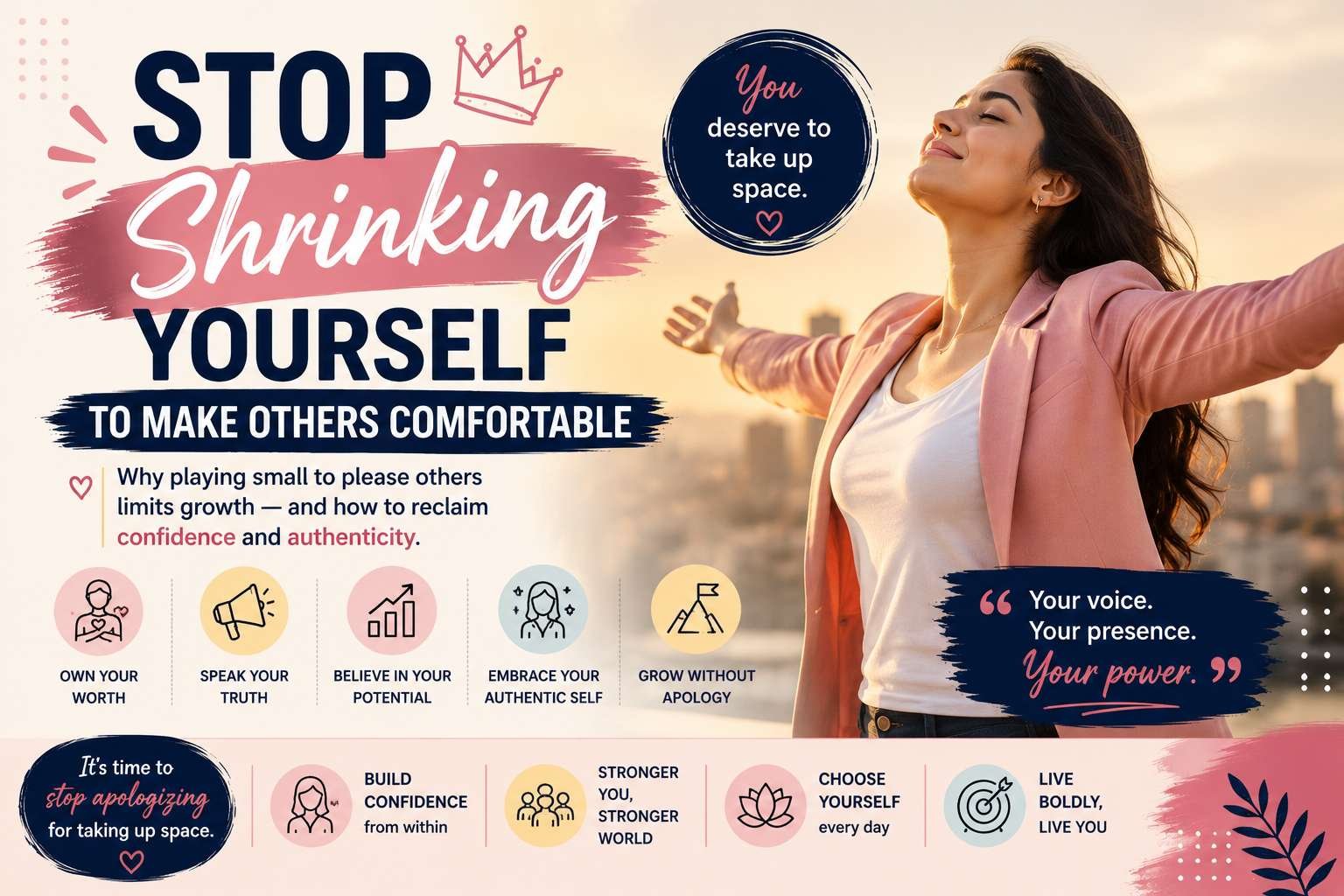
The Habit of Playing Small
Many women are taught, often unconsciously, to make themselves smaller — to speak softly, to not take up too much space, to avoid being “too much.” This conditioning starts early, reinforced by social expectations that reward politeness over power and modesty over confidence.
Over time, this habit of shrinking becomes second nature. It shows up in meetings where women hesitate to share ideas, in friendships where they downplay achievements, and in relationships where they silence their needs to keep peace.
But shrinking doesn’t serve anyone — not the individual, not the workplace, and not society.
Why We Shrink Ourselves
Shrinking often comes from a desire to be accepted. Many women fear being labeled as arrogant, aggressive, or self-centered if they express confidence. Others worry about making people uncomfortable by standing out or succeeding.
This fear of judgment leads to self-censorship — speaking less, apologizing more, and settling for less recognition than deserved.
But confidence is not arrogance. Taking up space is not selfish. It’s a reflection of self-respect.
The Cost of Playing Small
When women shrink themselves, they lose more than visibility — they lose opportunities, influence, and self-belief.
- In careers, it can mean staying silent in meetings or not negotiating for fair pay.
- In relationships, it can mean prioritizing others’ comfort over personal happiness.
- In personal growth, it can mean never exploring full potential out of fear of judgment.
The cost of shrinking is invisible but heavy — it limits what could be achieved if one simply allowed themselves to be seen and heard.
Signs You Might Be Shrinking Yourself
- Saying “sorry” too often, even when not at fault
- Avoiding eye contact or speaking softly in groups
- Downplaying achievements or success
- Staying quiet to avoid conflict
- Feeling guilty for wanting more
- Seeking approval before expressing opinions
Recognizing these patterns is the first step toward change.
How to Stop Shrinking Yourself
1. Acknowledge Your Worth
Confidence begins with self-awareness. Reflect on achievements, strengths, and values. Write them down. Seeing them in words reinforces self-belief.
2. Speak Without Apology
Replace “I’m sorry, but…” with “I think…” or “In my experience…” Every time you speak confidently, you reclaim your voice.
3. Take Up Space — Physically and Emotionally
Stand tall, make eye contact, and express opinions clearly. Taking up space is not dominance; it’s presence.
4. Celebrate Achievements
Share successes without guilt. When women celebrate themselves, they inspire others to do the same.
5. Surround Yourself with Supportive People
Confidence grows in environments that encourage authenticity. Build a circle that uplifts rather than diminishes.
6. Redefine “Comfort”
If someone feels uncomfortable with confidence, it’s not a reflection of the confident person — it’s a reflection of their own insecurities. True comfort comes from mutual respect, not self-suppression.
7. Practice Saying “No”
Boundaries are a form of self-respect. Saying no doesn’t make anyone difficult; it makes them clear about priorities.
The Power of Being Seen
When women stop shrinking, they give others permission to do the same. Visibility creates representation, and representation creates change.
Every time a woman speaks up, leads boldly, or celebrates her success, she challenges the narrative that confidence is something to hide.
Embracing Authenticity
Authenticity is not about perfection — it’s about alignment. It means showing up as the truest version of oneself, even when it feels uncomfortable.
When women embrace authenticity, they stop living for approval and start living with purpose. They stop apologizing for being ambitious, outspoken, or passionate — and start owning their power unapologetically.
