

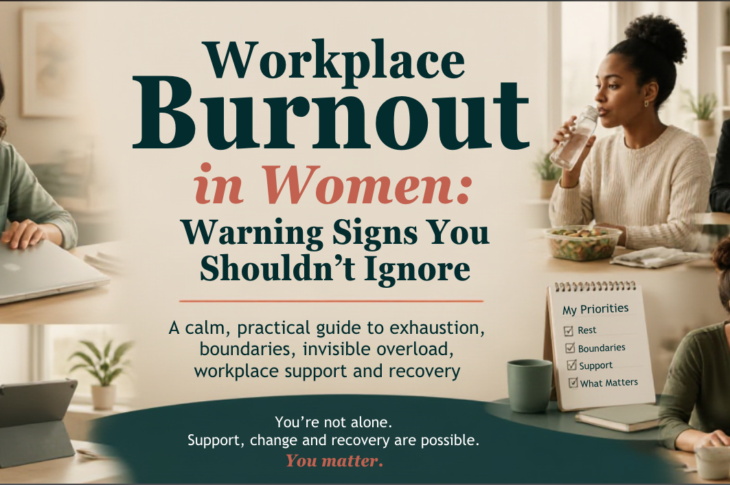
A calm, practical guide to recognising sustained overload, protecting recovery and asking for support.
You answer one more work message after dinner, join a meeting while exhausted and realise you have forgotten to eat or drink. Your focus feels unreliable, but the workday is not finished: there are household tasks, children, an older relative, a partner, or someone else who depends on you. From the outside, you may still look capable and dependable. Inside, you may wonder whether you are simply tired, failing at time management or losing motivation.
Burnout is not a personal weakness. It can develop when work-related demands continue without adequate recovery, support or control. This article is educational information, not a diagnosis, therapy substitute or personalised medical advice. A symptom list cannot explain every cause of distress.
What workplace burnout is—and what it is not
Burnout is a pattern of work-related exhaustion, mental distance or cynicism, and a reduced sense of effectiveness. It may arise when demands persist while recovery, staffing, recognition, fairness or control remain inadequate. A high-performing, caring or successful person can still be burned out.
Burnout is not laziness, lack of ambition, a character flaw or proof that someone chose the wrong career. Rest matters, but telling an overburdened person to practise self-care without addressing workload and working conditions is incomplete.
|
Keep in mind: Burnout is shaped by both personal wellbeing and workplace conditions. Individual coping habits may help, but they cannot replace fair workloads, safe workplaces, reasonable boundaries, adequate staffing and organisational responsibility. |
Why women may be especially vulnerable to invisible overload
Women may be expected to organise, remember, smooth conflict, mentor colleagues and remain emotionally available alongside paid work. Mental load, unpaid labour, caregiving, single parenting, financial uncertainty, discrimination, harassment, inaccessible workplaces and limited control can all add pressure.
These are possible contexts, not universal experiences. Burnout risk is influenced by systems and resources, not only by individual resilience. Workload, recognition, fairness, values, community, job security, health and the ability to recover all matter.
- Invisible work — the planning and emotional labour others may not see.
- Unequal flexibility — policies that exist on paper but are difficult to use safely.
- Competing responsibilities — paid work alongside care, health, household or financial demands.
Warning sign 1: Exhaustion that does not resolve with ordinary rest
You wake tired, feel depleted before work or need all available time to recover. A busy week can make anyone tired; sustained depletion deserves attention, especially when rest no longer restores you.
Warning sign 2: Cynicism, detachment or dread
You may feel irritable, numb, resentful or unable to care about work that once mattered. You might avoid people, dread opening your inbox or feel emotionally distant as a way to conserve energy.
Warning sign 3: Reduced concentration and more mistakes
Forgetfulness, indecision, repeated errors, slower processing, losing track of conversations or taking much longer with familiar tasks can signal that your capacity is stretched.
Warning sign 4: Physical and sleep changes
Headaches, muscle tension, stomach upset, appetite changes, racing thoughts at night, disrupted sleep or frequent minor illness can occur alongside overload. Do not automatically attribute these to burnout; seek medical advice if symptoms persist, change suddenly or concern you.
Warning sign 5: Emotional changes and loss of capacity
Tearfulness, shame, hopelessness, feeling trapped or being unusually reactive deserve support. These experiences have many possible causes and are not proof of burnout on their own.
Warning sign 6: Boundaries disappearing
You check messages constantly, work through breaks, feel guilty for resting, cannot say no or treat every request as urgent. Constant availability can look like commitment while quietly removing recovery time.
Warning sign 7: Carrying a second shift at home
After paid work, you immediately manage cooking, cleaning, childcare, elder care, household logistics or emotional support without enough shared responsibility. The transition from work to home may never really happen.
|
These signs are signals, not a verdict. They may reflect work stress, another health concern, several overlapping pressures or something else entirely. Notice patterns without turning them into a self-diagnosis. |
Burnout versus ordinary tiredness, stress, depression and anxiety
No single feeling separates these experiences. The pattern, duration, impact and context matter, and a qualified clinician is the right person to assess possible causes.
|
Experience |
What may be different |
|
Ordinary tiredness |
May improve with food, sleep, rest or a short recovery period. |
|
Everyday stress |
May be temporary and linked to a specific demand, although it can still need support. |
|
Burnout |
May involve longer-lasting exhaustion, detachment and reduced effectiveness connected with work-related demands. |
|
Depression or anxiety |
Can affect many areas of life. Depression may include persistent low mood, loss of interest, hopelessness or thoughts of death; anxiety may include persistent worry, panic, tension or avoidance. |
Burnout and depression or anxiety can coexist. Physical conditions, sleep problems, hormonal changes, anaemia, infection, medication effects and other health issues can resemble or worsen exhaustion. Seek professional assessment rather than trying to label yourself.
A gentle burnout check-in
Reflect on the last two to four weeks without turning your answers into a score:
- How has my energy changed before, during and after work?
- Am I recovering between workdays, or only surviving until the next one?
- Which demands are fixed, negotiable, unclear or unsafe?
- What support, accommodation, staffing or boundary would make a material difference?
- Are sleep, appetite, health, relationships or basic functioning changing?
- What can I pause, delegate, clarify or escalate?
What to do this week: reduce, clarify, communicate, recover
- Reduce — pause, shorten or defer one low-value task, meeting, notification or commitment where possible.
- Clarify — ask which deadline, deliverable or priority matters most. Request written priorities when work is unclear.
- Communicate — describe observable workload and impact to a manager, HR, occupational-health professional, union representative or trusted colleague, considering safety before sharing personal details.
- Recover — protect meals, hydration, sleep opportunity, movement, quiet time and connection as basic wellbeing needs, not performance hacks.
- Seek care — contact a doctor or qualified mental-health professional when symptoms persist, intensify, affect functioning or feel difficult to manage.
How to talk with a manager or workplace support
Try practical wording: “I’m managing a sustained workload that is affecting my concentration and recovery. Can we review the top priorities, deadlines and what can be paused?”
You could also say: “I can complete A by Friday or A and B by next week. Which outcome is most important?” or “I need clearer ownership and a realistic response expectation outside working hours.”
Document workload, deadlines, requests, agreed priorities and follow-up dates. If there is retaliation, harassment, discrimination or safety risk, seek confidential advice from an appropriate local professional, union, advocate or service. Not every workplace responds well, and you do not have to disclose more than is safe.
Boundaries for emails, meetings and after-hours work
Use a shutdown note with unfinished items, next steps and tomorrow’s first priority. Set realistic response windows and status messages where permitted. Ask for an agenda or written update, and decline or shorten meetings without a clear purpose when appropriate.
Keep urgent channels distinct from routine messages, while preserving accessibility, caregiving, health and safety exceptions. Do not ignore genuine emergencies or essential on-call duties; clarify what is truly urgent, who covers it and how recovery time is handled.
For remote work, create start and stop cues and a transition ritual that fits your home and care reality. A short walk, changing clothes, closing a notebook or moving to another room can help mark the boundary without pretending home circumstances are identical for everyone.
Caregiving, disability, chronic illness, remote work and shift work
Plans should account for fluctuating energy, medical appointments, assistive technology, sensory needs, medication, sleep schedules and care responsibilities. Shift workers may need recovery anchors rather than a conventional Monday-to-Friday routine.
Caregivers should not be told to simply “set boundaries” when staffing or household support is absent. Include shared responsibility, practical help and workplace flexibility. Reasonable accommodations and employment rights vary by location, so seek qualified local advice rather than relying on universal legal claims.
|
Urgent support matters. If you have thoughts of self-harm, frightening thoughts, abuse, domestic violence or immediate danger, contact qualified urgent support or emergency help in your location. Do not frame an immediate safety concern as merely workplace stress. |
What colleagues, managers and organisations can do
Ask about workload and priorities, not only resilience. Resource work realistically, address chronic understaffing and avoid rewarding constant availability. Make breaks, leave, flexible work and accommodations usable without stigma or retaliation.
Train managers to notice changes without diagnosing or forcing disclosure. Address harassment, discrimination, bullying and inequity through clear processes. Respect privacy and avoid turning wellbeing programmes into surveillance or individual blame. A meditation app cannot compensate for impossible deadlines or unsafe conditions.
Common mistakes and better alternatives
- Mistake: treating burnout as a time-management failure.
- Better: examine workload, control, staffing and recovery.
- Mistake: adding a long self-care checklist.
- Better: choose one restorative action and one structural conversation.
- Mistake: waiting for crisis.
- Better: raise patterns early with observable examples.
- Mistake: replying to everything immediately.
- Better: clarify urgency and response expectations.
- Mistake: hiding symptoms to appear dependable.
- Better: share the minimum necessary through a safe support route.
- Mistake: assuming leave alone solves the cause.
- Better: review workload and conditions before and after returning.
Do/Don’t guidance
- Don’t call yourself lazy.
- Do investigate sustained demands and recovery.
- Don’t diagnose yourself from a checklist.
- Do seek qualified assessment when symptoms persist or interfere with life.
- Don’t treat constant availability as commitment.
- Do define realistic communication norms.
- Don’t carry invisible labour silently.
- Do make tasks, ownership and support visible.
- Don’t make a major career decision in your most depleted moment without support, unless safety requires immediate action.
- Do gather information and options.
- Don’t ignore harassment, discrimination, threats or unsafe conditions.
- Do seek confidential, local support.
- Don’t reduce the solution to self-care.
- Do combine recovery with workload and workplace changes.
A 7-day recovery-and-boundaries reset
This is a gentle observation and support experiment, not a cure or productivity challenge.
- Day 1: Note energy, sleep, workload and the strongest depletion point without judging yourself.
- Day 2: List active demands and mark what can be paused, delegated, clarified or escalated.
- Day 3: Protect one recovery need, such as a meal, water break, sleep opportunity or quiet transition.
- Day 4: Send one clear priority or workload question to the appropriate person.
- Day 5: Create one email, meeting or after-hours boundary with necessary exceptions.
- Day 6: Contact a trusted person, clinician, occupational-health service, union or workplace support route as appropriate.
- Day 7: Review what changed, what did not and one sustainable adjustment to carry forward.
Five small actions to start today
- Write down the work demand most affecting your recovery.
- Ask which priority matters most when everything appears urgent.
- Take one real meal, hydration or movement break without treating it as a reward.
- Turn off one non-essential after-hours notification if safe and practical.
- Tell one appropriate support person what you need, using observable examples.
Mini checklist
- Has my exhaustion lasted beyond an ordinary busy period?
- Am I recovering between workdays?
- Have cynicism, dread, detachment or irritability increased?
- Are concentration, memory, sleep, appetite or physical symptoms changing?
- Am I working through breaks or checking messages constantly?
- What invisible labour or caregiving am I carrying?
- Which demand can I reduce, clarify, delegate or escalate?
- Is there a safe manager, clinician, union, occupational-health or support route?
- Could another health condition or medication effect be contributing?
- Are harassment, discrimination, coercion or safety concerns involved?
- What small recovery need can I protect today?
