

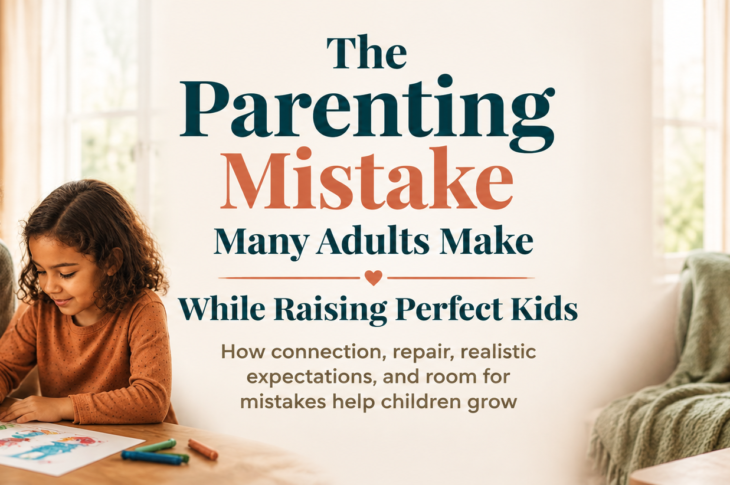
The parenting mistake: confusing a loved child with a perfect child
Your child brings home a drawing with colours outside the lines, a test result that is lower than expected, a muddy sports uniform, or a school project held together with too much tape. Before you ask what they enjoyed, discovered, or found difficult, you point out the missing detail, the untidy edge, the careless error, or the behaviour that might reflect badly on the family.
Most adults do this because they care. They want children to grow into capable, responsible people who can cope with life. The common mistake is not caring about growth. It is quietly turning “raising capable children” into “raising perfect children,” as if approval depends on flawless results, constant obedience, high achievement, emotional control, or making adults look good.
Children need guidance, limits, accountability, and high-support expectations. They also need room to make age-appropriate mistakes, ask questions, feel difficult emotions, try again, and remain loved when the outcome is imperfect. The goal is not to remove standards. It is to separate a child’s worth from performance.
|
Key idea: A child can be responsible without being flawless, ambitious without being anxious, and accountable without being shamed. |
What perfection-focused parenting can look like in everyday life
Perfection-focused patterns are often ordinary moments repeated over time, not evidence that a parent or caregiver is uncaring. Any one behaviour can have many meanings and should be understood in context, including a child’s age, development, disability, communication style, culture, stress level, and safety needs.
- Correcting first: Fixing a child’s work before asking what they enjoyed or learned.
- Making mistakes moral: Turning a forgotten item or spilled drink into a lecture about character.
- Rewarding only outcomes: Praising winning, being gifted, being attractive, being useful, or being “easy.”
- Comparing: Measuring siblings, cousins, classmates, or children online against one another.
- Over-scheduling: Filling every hour to prevent boredom or the fear of falling behind.
- Taking over: Answering every question or fixing every problem instead of allowing safe effort.
- Protecting appearances: Expecting children to manage adult emotions or preserve the family image.
- Misreading distress: Treating tears, anger, fear, or sensory overwhelm as deliberate disrespect.
- Apologising for difference: Acting embarrassed by a child’s disability, neurodivergence, language, interests, or pace.
- Expecting instant maturity: Saying “you should know better” when a child is still learning.
These patterns can appear in families balancing work, caregiving, financial pressure, migration, illness, grief, or limited support. They can also appear in households with parents, grandparents, foster or adoptive caregivers, stepfamilies, single parents, co-parents, guardians, teachers, or extended family sharing responsibility. The answer is curiosity rather than blame.
Why children need room for mistakes and repair
Mistakes are how children gather information about themselves, other people, and the world. A child who drops a cup may need help cleaning it. A child who loses a game may need comfort and a break. A child who lies may be frightened, confused, or trying to avoid a consequence. None of these moments requires pretending that behaviour does not matter. They require a response that makes safety, responsibility, and repair possible.
When adults correct every detail, schedule every minute, prevent every disappointment, or demand constant politeness, children may learn to hide mistakes instead of seeking help. That does not mean one impatient comment causes lasting harm. Repeated patterns matter, as do context, support, and the possibility of change. Connection can be rebuilt many times.
High expectations versus perfectionism
High expectations communicate belief in a child’s capacity while also offering support, access, and flexibility. Perfectionism makes acceptance feel conditional and treats an imperfect outcome as evidence of a flawed person.
|
Healthy expectation |
Perfectionism or shame |
|
Please put your art supplies away so the shared space is usable. I’ll help you make a plan. |
Your room is always a disaster. What is wrong with you? |
|
You worked hard. Let’s look at what was difficult and what you want to practise. |
You got this wrong again. You must do better. |
|
I won’t let you hit. We can take space and find words for what happened. |
Good children never lose control. |
|
Tell me the truth so we can solve this safely. |
If you loved me, you would never disappoint me. |
Boundaries can be firm while language remains respectful and age-appropriate. Kindness is not permissiveness, and accountability is not humiliation. A caregiver can stop unsafe behaviour, require repair, and still communicate, “You are not bad. We are dealing with what happened.”
The difference between guidance, control, and shame
Guidance gives a child information, choices, practice, and a clear limit. Control tries to manage every outcome, feeling, preference, or public impression. Shame turns a behaviour into a verdict about who the child is or whether they deserve closeness.
Ask yourself: Is this about safety, respect, shared responsibility, or my discomfort with imperfection? Does the child understand what to do next? Is the expectation accessible? Can I offer a visual schedule, extra processing time, movement, a sensory break, captions, alternative communication, or a predictable transition?
Children with different temperaments, learning differences, disabilities, sensory needs, languages, and communication styles may need different routes to the same shared goal. Support is not lowering the standard. It is making participation possible.
How adult anxiety and social comparison can shape parenting
Adults may fear that a child’s mistake predicts future failure, reflects badly on the family, or means other children are getting ahead. Social media can make ordinary family life look like a constant showcase of achievement, enrichment, neatness, and calm. A photograph rarely shows the tired morning, the inaccessible activity, the private grief, or the support that made the moment possible.
Before reacting, try asking: “Is this expectation about the child’s need, or my fear of judgment?” “Does this activity build capacity, or only display success?” “Am I correcting a safety issue, a shared responsibility, or my own discomfort with imperfection?” These questions are invitations to pause, not reasons to criticise yourself.
Signs a child may feel valued mainly for performance
No single sign proves what a child is experiencing. Notice patterns across settings and over time, and consider anxiety, bullying, learning differences, sensory overload, grief, illness, family stress, or other experiences.
- Hiding mistakes, incomplete work, accidents, or disappointing news.
- Extreme distress over ordinary errors or losing.
- Saying “I’m stupid,” “I’m bad,” or “you won’t love me” after a mistake.
- Avoiding new activities unless success is guaranteed.
- Constantly seeking reassurance or asking whether work is good enough.
- Over-apologising, lying to avoid criticism, or blaming others defensively.
- Difficulty resting, playing, or enjoying activities without an outcome.
- Worry about adult disappointment, family reputation, or comparison.
- Becoming unusually withdrawn, irritable, controlling, or overwhelmed.
How to respond when things go wrong
Adapt these scripts to age, language, safety, development, and the child’s communication needs. A script is a starting point, not a performance test for the adult.
- When a child fails: “This result tells us what needs more practice. It does not tell us your worth. What part felt hardest?”
- When a child makes a mess: “Accidents happen. Let’s make the area safe and clean it together.”
- When a child tells the truth: “I’m glad you told me. We still need to address what happened, and honesty helps us do that.”
- When a child melts down: “I won’t let you hurt anyone. Your body seems overwhelmed. We can talk when it is calmer.”
- When a child refuses: “You can dislike the plan. The limit still applies. Let’s choose between these two safe options.”
- When a child loses: “It’s okay to feel disappointed. Do you want comfort, a break, or to talk about trying again?”
Urgent safety issues, abuse, severe distress, developmental concerns, or persistent behavioural changes require appropriate support from a qualified local professional rather than relying only on a parenting article.
Praise effort, process, honesty, courage, and repair without creating another performance test
Notice specific effort, strategies, persistence, honesty, kindness, curiosity, collaboration, courage, recovery, and asking for help. Descriptive feedback helps children understand what they did without attaching a fixed identity to it: “You kept trying different ways to solve it” is more useful than “You are the smartest.”
Do not replace “perfect” with “the most hardworking” as another conditional identity. Do not turn every effort into a demand for more effort. Celebrate rest, play, privacy, boundaries, and self-advocacy as well as achievement. Let children enjoy activities without photographing, posting, ranking, or monetising every moment.
Boundaries and consequences that teach rather than humiliate
A useful consequence relates to the behaviour, is proportionate, predictable, and focused on safety or repair. If a child spills paint, cleaning together may make sense. If a child damages a shared item, they may help repair or replace it in an age-appropriate way. If a child hits, the immediate priority is safety, followed later by support for naming feelings and planning alternatives.
Avoid humiliation, threats to withdraw love, public shaming, physical punishment, forced confession, or using a child’s vulnerability against them. A child’s nervous system, disability, age, and circumstances can affect how a task is approached without removing the boundary. If behaviour creates immediate danger, prioritise safety and seek appropriate support.
Helping children develop emotional literacy and self-compassion
Emotional literacy is more than naming pleasant feelings. Children can gradually learn to notice body signals, identify emotions, communicate needs, tolerate pauses, and choose safe support. Use simple language: “Your fists are tight and your voice is loud. Are you angry, worried, or overloaded?” Offer words, pictures, gestures, objects, or communication tools when speech is difficult.
Self-compassion does not excuse harm. It helps a child say, “That was hard, and I can learn what to do next,” instead of “I am bad, so there is no point trying.” Adults can model this by acknowledging their own mistakes without making the child provide comfort.
Age-appropriate independence and decision-making
Offer real choices within safe limits. A young child might choose between two shirts or help place books on a shelf. A school-age child might plan part of a routine, check a list, or decide how to practise. A teenager might discuss priorities, privacy, transport, study, rest, and consequences with increasing ownership.
Independence is not doing everything alone. It can mean requesting help, using an accessibility tool, taking a sensory break, communicating a boundary, or deciding that a task needs more time. Adjust expectations for development, disability, health, language, culture, and family circumstances.
Sibling comparison, school pressure, social media, and family expectations
Siblings may share a home and still need different routines, supports, freedoms, and forms of encouragement. Comparing one child’s grades, body, friendships, pace, or temperament with another’s can turn difference into competition. Instead, describe the specific responsibility in front of each child and protect each child’s privacy.
School pressure, online comparison, community expectations, and family traditions can all shape what adults fear. Culture, language, religion, migration history, and hopes for the future deserve respect, but they should not require a child to become a public symbol of family success. Talk about values such as responsibility, belonging, curiosity, care, and safety rather than a single image of achievement.
Repairing after a parent overreacts
Every caregiver has moments when stress, fear, exhaustion, illness, work demands, or limited support make a reaction stronger than intended. Return to the child when everyone is calmer. Name the adult’s behaviour without making the child comfort the adult: “I raised my voice, and that was not respectful.” Re-state the boundary clearly: “The rule still matters, and I’m going to explain it calmly.” Invite the child’s perspective without demanding immediate forgiveness, then make a practical plan for next time.
Repeat repair consistently. One apology does not erase a pattern, but repair is still meaningful. If a caregiver repeatedly feels out of control, overwhelmed, or frightened by their reactions, seeking support from a qualified mental-health or parenting professional can help when accessible and safe.
A realistic 7-day “connection over perfection” reset
Treat this as an experiment, not a perfect challenge. Adapt it for babies, toddlers, teens, disabled children, neurodivergent children, school schedules, work shifts, illness, and family traditions.
- Day 1: Notice one moment when you corrected before connecting; write what the child may have needed first.
- Day 2: Ask one open question about the child’s experience without evaluating the result.
- Day 3: Allow one safe, age-appropriate task to be imperfect without taking over.
- Day 4: Replace one comparison or label with specific descriptive feedback.
- Day 5: Practise one calm boundary and one related consequence.
- Day 6: Share a few minutes of unstructured connection with no teaching, posting, testing, or performance goal.
- Day 7: Repair one recent tense moment and choose one pattern to keep practising.
Five small actions to start this week
- Before correcting, ask one curious question.
- Separate the behaviour or result from the child’s worth.
- Notice one process, effort, feeling, or act of honesty.
- Hold one clear boundary without humiliation.
- Repair one moment when you reacted more strongly than you intended.
Mini checklist
- Is this about safety, respect, shared responsibility, or my fear of judgment?
- Is the expectation age-appropriate and accessible?
- Have I connected before correcting when possible?
- Does the consequence teach repair rather than shame?
- Can the child ask for help without fearing rejection?
- Am I allowing rest, play, privacy, and a child’s own interests?
- Have I made room for different development, communication, and sensory needs?
- Do I need support from another trusted adult or qualified professional?
