







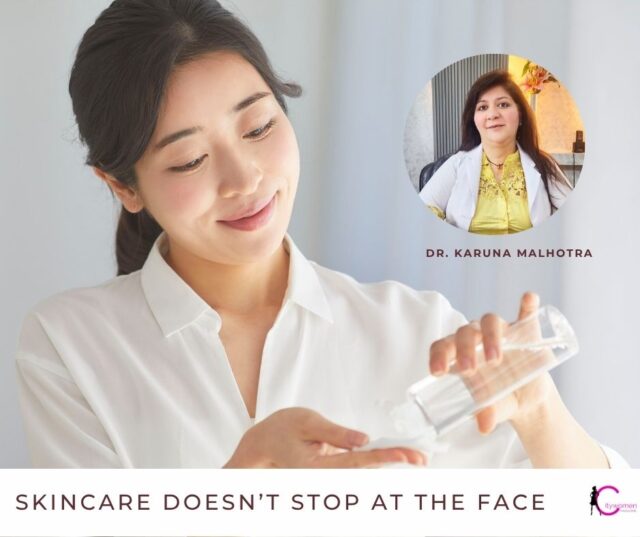
For years, skincare routines have largely revolved around the face—cleansers, serums, sunscreens, and anti-ageing creams dominating bathroom shelves. However, a noticeable shift is underway. Dermatologists are now seeing a growing awareness among patients that skincare should not stop at the jawline. The focus is expanding to include the entire body, and this change is not just a trend, but a more holistic approach to skin health.
According to Dr. Karuna Malhotra, Founder, Aesthetic Physician and Skin care expert from Cosmetic Skin and Homeo Clinic Rajouri Garden New Delhi this shift is driven by both awareness and evolving lifestyle habits. “People are beginning to understand that the skin on the body is just as important as the skin on the face. Concerns like dryness, pigmentation, and premature ageing don’t affect only the face—they appear across the body as well,” she explains.
One of the key reasons behind this growing focus is the increase in skin-related concerns beyond facial appearance. Issues such as body acne, uneven skin tone, tanning, and rough texture are becoming more common, especially in urban environments where pollution, stress, and irregular routines take a toll on overall skin health.
Rise of Body-Specific Concerns
Earlier, conditions like back acne, pigmentation on elbows and knees, or dryness on arms and legs were often ignored. Today, patients are more conscious and willing to address these concerns. Dermatologists report that more individuals are seeking treatments and products specifically designed for body care, rather than relying on basic soaps and lotions.
Another factor contributing to this trend is the growing influence of skincare education. With more information available, people are learning that the skin on different parts of the body has varying needs. For example, the skin on the arms and legs is thicker and may require stronger hydration, while areas like the neck and chest are more delicate and prone to early signs of ageing.
Advanced Ingredients Beyond the Face
Ingredients once reserved for facial skincare—such as retinol, glycolic acid, and niacinamide—are now being incorporated into body lotions and treatments. These ingredients help in exfoliation, improving texture, and boosting collagen production.Dr. Malhotra notes, “We are seeing a transition where people are no longer satisfied with basic moisturisation. They are looking for targeted solutions that improve skin quality over time.”
Sun exposure is another critical aspect often overlooked when it comes to body care. While sunscreen use on the face has become more common, many people still neglect applying it to the rest of the body. This can lead to tanning, pigmentation, and even long-term damage.
Importance of Sun Protection
Dermatologists emphasize that areas like the arms, neck, and hands are constantly exposed to sunlight and require equal protection. Incorporating sunscreen into daily body care routines is essential for preventing premature ageing and maintaining even skin tone.
The idea of “skin longevity” is also influencing this shift. Instead of focusing only on quick fixes, people are adopting long-term strategies to maintain healthy skin across the body. This includes regular exfoliation, hydration, and protection—practices that contribute to overall skin resilience.
Holistic Skincare Approach
Body skincare is no longer seen as an occasional indulgence but as an essential part of daily self-care. From choosing the right cleansers to using treatment-based body products, individuals are becoming more mindful of what they apply to their skin.
In conclusion, the growing focus on body skincare reflects a broader understanding of health and wellness. It is not just about appearance, but about caring for the skin as a whole. As Dr. Karuna Malhotra highlights, “Healthy skin is not limited to the face. When you take care of your skin from head to toe, it shows in both appearance and confidence.”
This evolving approach signals that skincare is no longer confined to the mirror—it is becoming a complete, head-to-toe commitment.