

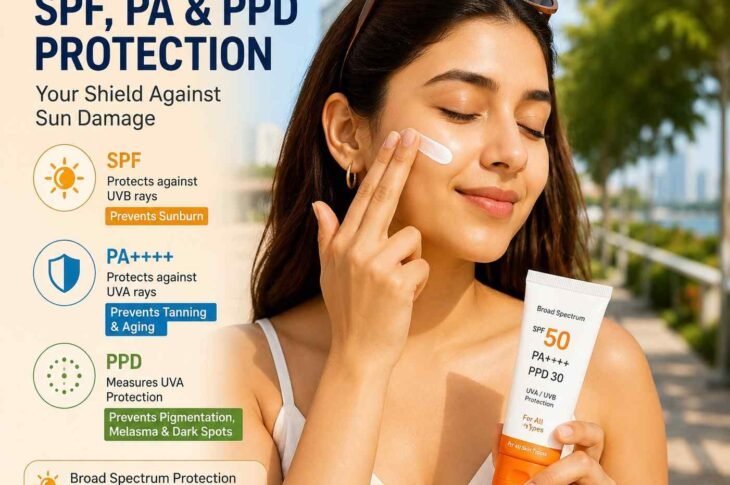
Think SPF is enough? Here’s why understanding PPD could make a huge difference in preventing tanning, pigmentation, and premature skin aging. SPF, PA & PPD: The Sunscreen Guide Every Indian Should Read Before Buying Their Next Sunscreen :
When shopping for sunscreen, most of us have learned to look for one thing—SPF. Over the last few years, many skincare enthusiasts have also started checking the PA rating. But recently, another term has been making its way into skincare conversations: PPD.
So, what exactly is PPD? Is it different from PA? And should you actually care about it?
If tanning, pigmentation, melasma, or uneven skin tone are your biggest skincare concerns, the answer is yes.
Let’s break it down in simple language.
What Does SPF Actually Mean?
SPF stands for Sun Protection Factor.
It tells you how effectively a sunscreen protects your skin against UVB rays, the part of sunlight mainly responsible for:
- Sunburn
- Skin redness
- Skin damage caused by overexposure
- Increased risk of skin cancer
A higher SPF generally means better protection against UVB rays.
For example:
- SPF 30 blocks about 97% of UVB rays.
- SPF 50 blocks about 98% of UVB rays.
However, SPF does not tell you everything about protection from the sun.
What About UVA Rays?
Unlike UVB rays, UVA rays penetrate deeper into the skin.
These rays are primarily responsible for:
- Tanning
- Pigmentation
- Melasma
- Dark spots
- Premature wrinkles
- Loss of skin elasticity
- Photoaging
For many Indians, these are the skin concerns they struggle with the most.
This is where PA and PPD become important.
What Does PA Mean?
PA stands for Protection Grade of UVA.
You’ll usually find sunscreen labels like:
- PA+
- PA++
- PA+++
- PA++++
The more plus signs, the better the UVA protection.
For most dermatologists, PA++++ is considered the highest commonly available PA rating.
But here’s something many people don’t know.
Why Isn’t PA++++ Enough?
A sunscreen labelled PA++++ doesn’t tell you exactly how much UVA protection you’re getting.
Two different sunscreens may both carry the PA++++ label, yet offer very different levels of UVA protection.
For example:
- Sunscreen A may have PPD 16
- Sunscreen B may have PPD 30
- Sunscreen C may have PPD 40
All three can still legally display PA++++.
That means PA gives you a category, while PPD gives you the actual number.
What is PPD?
PPD stands for Persistent Pigment Darkening.
It measures how well a sunscreen protects your skin against UVA rays.
Think of it as the UVA equivalent of SPF.
The higher the PPD number, the greater the protection from UVA-induced pigmentation and tanning.
Why PPD Matters for Indian Skin
Indian skin is naturally more prone to:
- Hyperpigmentation
- Tanning
- Melasma
- Post-acne marks
- Uneven skin tone
These conditions are strongly influenced by UVA exposure.
Even when you don’t get sunburned, UVA rays continue damaging the skin throughout the day because they can penetrate clouds and even glass windows.
If your goal is to reduce pigmentation and maintain an even complexion, focusing only on SPF may not be enough.
How to Choose a Good Sunscreen
When buying your next sunscreen, look for:
- SPF 30 or SPF 50
- Broad-spectrum protection
- PA++++
- A clearly mentioned PPD value, if available
Higher PPD values generally indicate stronger UVA protection.
Sunscreen Tips for Daily Use
To get the maximum benefit from your sunscreen:
- Apply sunscreen every morning.
- Use enough product to cover your face, neck, and exposed skin.
- Reapply every two to three hours when outdoors.
- Don’t forget your ears, neck, and hands.
- Wear hats or sunglasses for additional protection.
Even the best sunscreen won’t work well if it’s applied too little or not reapplied when needed.
SPF protects you from sunburn-causing UVB rays, while PA and PPD relate to UVA protection—the rays responsible for tanning, pigmentation, melasma, and premature skin aging.
If pigmentation is one of your biggest skincare concerns, don’t stop at checking the SPF. Look for a sunscreen that also offers strong UVA protection, and when available, pay attention to its PPD value.
Understanding these labels can help you choose a sunscreen that better matches your skin’s needs and supports healthier, more even-looking skin over time.
Note: Sunscreen labels and testing methods can vary by country and brand. If you have persistent pigmentation, melasma, or a skin condition, consult a dermatologist for personalized advice.
