True style isn't just about the clothes; it's about the command you hold while wearing them. Malaika Arora’s latest yellow ensemble is a masterclass in structural elegance and high-fashion authority.
Times are changing, technology is evolving, but has the mindset within the four walls of our homes truly shifted? It is often said that “a husband has rights after marriage,” but can this right exist against someone’s will? Jio Hotstar’s upcoming series ‘Chiraiya’ brings this stinging question to the forefront. It is the story of a ‘Chiraiya’ (little bird) who was kept in a cage, and eventually, her song was snatched away.
When War Begins Among Loved Ones
The 1-minute 43-second trailer takes us into a household where Divya Dutta’s brother forces himself upon his own wife. The twist in the tale arises when Divya Dutta (the sister-in-law) refuses to stay silent after seeing her sister-in-law’s tears. On one side is the bond of blood, and on the other, a woman’s dignity. While society, and even her husband (played by Sanjay Mishra), urge her to back down for the sake of tradition, Divya Dutta takes this battle all the way to the courtroom.
Marriage is Not a License for Coercion
In our society, the word ‘choice’ is often sacrificed at the altar of marriage. The trailer of ‘Chiraiya’ screams that a marriage certificate does not grant any man a license for violence or entitlement. This story mirrors the life experiences of thousands of women who are crushed under the weight of ‘duty’ every single night. Shashant Shah’s direction and SVF Entertainment’s production elevate this sensitive subject to a new height, making it a mirror for modern India.
A Powerhouse of Talent
The determination in Divya Dutta’s eyes and the nuanced performance of Sanjay Mishra make this series come alive. The presence of veteran actors like Tinnu Anand and Sarita Joshi adds further gravity to the narrative. Premiering on March 20, 2026, this series promises to be more than just entertainment—it is a knock on the closed doors of our social conscience.
Malaika Arora continues to redefine high fashion with her latest Instagram drop, proving why she remains the ultimate style icon. Draped in a breathtaking sun-kissed yellow ensemble by Self-Cntrd, she masterfully balances structural precision with fluid elegance.
The corset-style bodice paired with a sweeping, ethereal skirt creates a silhouette that screams power and grace. With minimalist jewelry by Maejoy and a radiant “golden hour” glow by Meghna Butani, Malaika transforms a simple pose into a high-fashion editorial. This look isn’t just an outfit; it’s a masterclass in commanding attention through bold color and impeccable fit.
In this article, we will take a deep dive into the concept of a mother’s “Mental Load”. We explore why mothers often find themselves as the unofficial “Project Managers” of the household and discuss practical ways to share this burden with the entire family.
1. The 9 PM Panic
Imagine it is 9:00 PM. A mother has finished all the kitchen chores, prepared the next day’s tiffin, and finally sits on the sofa for five minutes of peace. Suddenly, her child runs in from the bedroom and says, “Mummy, tomorrow is ‘Yellow Day’ at school… I need to wear a yellow t-shirt and bring a yellow fruit!”.
This is where the “9 PM Panic” begins. Her brain’s “hard drive” immediately starts scanning: Is there a yellow t-shirt at home? Is it washed and clean? If not, will the nearby shop still be open? Is there a mango or a banana in the fridge?. For the next hour, she transforms into a detective, a tailor, and a manager. But have you ever wondered why the responsibility of knowing it is “Yellow Day” fell solely on her shoulders?.
2. ‘Mental Load’: The Invisible Labor
Household chores are often limited to cooking, laundry, or cleaning. However, there is another invisible task called the “Mental Load”. In Indian society, a mother doesn’t just do the work; she is the household’s “Project Manager”. She is the one who remembers:
That children must wear white uniforms on Saturdays.
When the younger one’s next vaccine dose is due.
Whether the children’s PT shoes are clean or not.
Which of the 50 messages on the school WhatsApp group are actually important.
To check WhatsApp notifications before sleeping and immediately upon waking up.
What needs to be prepared for breakfast and lunch tiffins for everyone.
While a father might help by dropping the kids at school, the mother holds the entire “data” regarding what is inside the bag and what should be there. This constant planning is mentally exhausting.
3. The Pressure of the “Strong and Versatile” Woman
Recently, City Women Magazine discussed the terms “Strong Woman” and “Versatile (Sarvagun Sampann) Woman”. Are these words compliments or hidden pressures? In Indian culture, the definition of a “good mother” is someone who knows every tiny detail about the house.
If a child forgets something at school, society often views it as “mother’s negligence” rather than the child’s mistake. Due to this social pressure, mothers turn their brains into “living calendars”. They fear that if they don’t remember, their child will fall behind. This quest for perfection is the root cause of the 9 PM Panic.
4. WhatsApp Groups: A Blessing or a Burden?
Today, every class has its own WhatsApp group. In theory, this should make things easier, but in reality, it is an endless flood of information. Messages starting with “Dear Parents” often arrive late in the evening or at night.
Since mothers are usually the primary contacts in these groups, all the data lands directly in their minds. This digital “noise” prevents them from sleeping peacefully, as they feel compelled to check their phones constantly for new instructions.
How to Share the Burden with the Family?
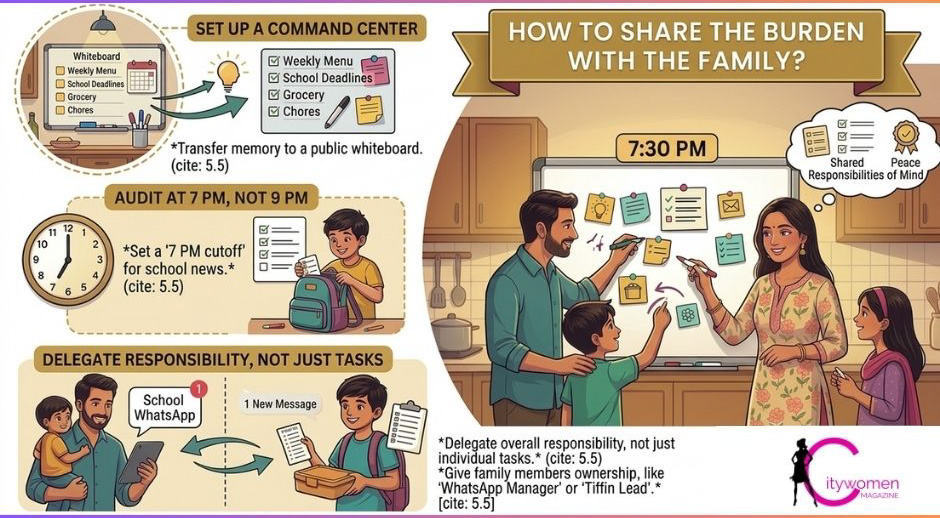
AI generated image : How to Share the Burden with the Family?
How to Exit ‘CEO’ Mode?
The only way to escape this mental exhaustion is by sharing responsibilities. The home must be run as a team rather than a “one-woman show”. Here are some practical suggestions:
The Whiteboard: Instead of keeping all the data in your head, shift it to a wall in the house. Put a whiteboard in the kitchen listing the weekly school schedule, grocery lists, and important dates. Make it a rule: if someone needs something, they must write it on the board. This makes information public and clears the mother’s mind.
7 PM Prep for the Next Day: Establish a rule to prepare for the next day at 7:00 PM instead of 9:00 PM. Shoes, dresses, and stationery should all be checked by then. If it isn’t mentioned by 7 PM, there will be no late-night scramble. This also instills a sense of responsibility in children.
WhatsApp Partnership: Why should only the mother’s number be in school groups?. Fathers should also be actively involved. One week the mother and the next week the father can take on the role of “Group Manager”.
Raising Independent Children: Sometimes the 9 PM Panic happens because we provide too much “service” to our kids. Children over 10 can pack their own bags and check their uniforms. Let them face the consequences of small mistakes, like forgetting PT shoes once. Once they are held accountable at school, they will start remembering their own things. A mother’s role should be the “backup,” not the “main server”.
It is vital to realize that you are a human being, not a super-computer. Forgetting “Yellow Day” or a chart paper once or twice does not define your worth as a mother. City Women Magazine has always encouraged women to connect with themselves and explore practices like “nature therapy”.
The 9 PM Panic is a symptom of a system where the entire load rests on one shoulder. Shed this burden. Talk to your partner, make your children responsible, and most importantly—drink that 9 PM cup of tea in peace. A “Strong Woman” is not one who does everything alone, but one who knows when to say “no” and when to ask for help.
Wait, are you also neglecting your lips the most in your skincare routine?
We have a 10-step glass skin routine. We even have the most expensive face sunscreen that smells like a tropical vacation. We even wear hats to protect ourselves from the harsh sun. But what about your beautiful lips? They’re burning without any UV protection. Lip care isn’t complete with just a gloss or lipstick.
If your lips feel “tight” or “chapped” after a day out, I hate to be the one to tell you this, but they aren’t just thirsty. They’re sunburnt.
Why is everyone suddenly obsessed with SPF Lip Balms?
If you’ve noticed your favorite influencers carrying around tiny tubes like they’re holding the secret to eternal youth, it’s because the beauty market finally woke up. The “Lip Care Market” is projected to hit nearly $2 Billion by 2031, and a huge chunk of that is people realizing that aging doesn’t stop at the lip line.
It’s trending because we’re moving past “just moisture” into “protection.” It’s the “Clean Girl” aesthetic meets “I don’t want lip cancer” reality.
The Scary Part (Why You Actually Need This)
Your lips are weird. In a biological way.
Zero Melanin: They have almost no melanin (the stuff that protects skin from the sun). They’re essentially defenseless.
Paper Thin: The skin on your lips is 3 to 5 times thinner than the rest of your face.
No Oil Glands: They can’t moisturize themselves. They just sit there and bake.
When you don’t use SPF, the sun destroys collagen. This leads to those “smoker lines” (even if you don’t smoke) and permanent darkening or pigmentation.
The “Wait, Really?” Benefits
Anti-Aging: Stop the vertical wrinkles before they start.
Prevents Pigmentation: Ever notice your lip line getting a bit… blurry or darker? That’s the sun. SPF keeps your natural color intact.
No More “Fake” Chapping: A lot of what we think is “dryness” is actually chronic low-grade sun damage.
Health: Lowering the risk of Actinic Cheilitis (a scary-sounding precancerous condition).
How to Choose Your “Bodyguard”
Don’t just grab the first waxy stick you see at the pharmacy. Here’s how to choose:
The SPF Number: Don’t settle for SPF 15. Experts suggest SPF 30 or higher for actual protection.
Broad-Spectrum: If it doesn’t say “Broad-Spectrum,” it’s only half-working. You need it to block both UVA (aging) and UVB (burning) rays.
Mineral vs. Chemical: If you have sensitive lips, look for Zinc Oxide or Titanium Dioxide. They sit on top and reflect the sun.
The “Yum” Factor: Since you’re basically eating this all day, look for shea butter, vitamin E, or hyaluronic acid. Avoid heavy artificial fragrances if you’re prone to irritation.
The Golden Rule: Reapply
You eat. You talk. You drink coffee. You lick your lips. Your SPF is gone in 20 minutes. If you’re outside, you need to re-swipe every 2 hours.
So, are we going to keep letting our lips sizzle like a summer BBQ, or are we going to buy the balm? Your future, non-wrinkled self is waiting.
Step into a world where traditional craftsmanship meets modern sophistication, where every detail is a delicate dance of white and silver. This week, we’re diving head-first into Sanya Malhotra’s recent sartorial triumph—a breathtaking fusion look that has left us utterly spellbound. Styled by the talented Manisha Melwani and Harshita Samdariya, and captured through the lens of Kanna Srihari, Sanya Malhotra’s ensemble is more than just an outfit; it’s a testament to the power of thoughtful curation and the beauty of reimagined style.
At the core of this mesmerizing look is a creation by Mohammed Mazhar. Sanya dons a pure white ensemble that redefines monochromatic dressing. The piece, with its unique halter-style neckline and backless drape, is a blend of modern sculpture and classic allure. The heavy cut-work embroidery, featuring delicate leaf motifs, adds a tactile, almost 3D element to the white fabric, creating depth and visual interest that standard prints can’t match. This isn’t just an outfit; it’s wearable art that demands a closer look.
While the white base of the outfit sets a pristine stage, the jewels by Harubhai Zaveri are the true scene-stealers. Sanya Malhotra has always been a champion of accessories, and this look is no exception. Let’s break down the key pieces:
1. The Statement Ear-Cuffs
These aren’t your average earrings. These are elaborate silver ear-cuffs that trace the delicate curve of her ear. The design features traditional Indian “jhumka” droplets, yet the form—a cascading waterfall of silver and intricate filigree—is entirely modern. This is how you bridge the gap between vintage charm and contemporary cool. It’s a bold choice that perfectly frames her face and adds an element of unexpected drama.
2. The Hathphool and Ring
Bringing a touch of old-world romance to the look is the silver hathphool, or hand-harness. Connected to an equally intricate ring, this piece drapes elegantly across the back of her hand, adding a delicate yet traditional flourish. It’s the perfect accessory to add a subtle hint of traditional elegance without overpowering the modern halter-neck drape.
The attention to detail is remarkable, even in the ring. Look closely, and you’ll see a tiny bindi-like motif etched into the silver, echoing the small black bindi Sanya wears, a subtle nod to traditional Indian beauty that ties the entire look together.
Hair & Makeup: Soft, Natural, and Radiant
To balance the strong sculptural form of the dress and the ornate jewelry, the HMU team—led by Natasha Mathias with assistant Janvi —opted for a soft, understated beauty look. Sanya’s natural, curly hair is pulled back into a soft, textured low bun, allowing the incredible ear-cuffs to take center stage. Her makeup is clean and radiant—think dewy skin, a subtle pink lip, and a tiny black bindi. It’s a “clean girl” aesthetic with a distinctively Indian heart, proving that sometimes, less truly is more.
A Vision in White and Silver
Sanya Malhotra’s Mohammed Mazhar look is a celebration of artistry, personal style, and the timeless appeal of fusion wear. It’s a perfect case study in how to mix traditional Indian elements (like cut-work embroidery, hathphools, and elaborate earrings) with modern silhouettes (a backless, halter-style drape). The result is a look that is both cutting-edge and deeply rooted in heritage. If there was ever a look that defined “ethereal elegance,” this is it. We’re officially obsessed!
Get the Look:
While we can’t all get our hands on this custom piece, we can certainly be inspired by its essence. Focus on monochromatic whites, experiment with halter necklines or open-back drapes, and look for statement silver jewelry with traditional motifs like jhumkas or hathphools. Remember, the key is balance: let one strong element (in this case, the jewelry) stand out while everything else (the simple white fabric, the soft makeup) supports it. Happy styling!
Board and final exams are an important phase in a child’s academic life, but they often bring intense pressure—not just from school, but from the family environment as well. Many children feel stressed not because of the syllabus, but because of constant expectations, comparisons, and fear of disappointing their parents. Reducing family pressure during exams is one of the most powerful ways parents can support their child’s success and mental well-being.
One of the biggest sources of pressure is unrealistic expectations. When parents focus only on marks or ranks, children begin to equate their self-worth with exam results. It is important to remind children that exams measure performance, not potential or intelligence. Encouraging effort, consistency, and improvement helps children stay motivated without feeling overwhelmed.
The home environment plays a crucial role during exam time. Frequent discussions about results, repeated reminders to study, or comparing children with siblings and classmates can increase anxiety. Instead, parents should aim to create a calm and predictable routine. Simple actions like maintaining normal family conversations, avoiding negative comments, and respecting study time can significantly reduce stress.
Communication is another key factor. Children need to feel safe sharing their fears and doubts without being judged. Listening patiently, acknowledging their emotions, and offering reassurance can help children feel supported. Sometimes, just knowing that their parents understand them can ease half the pressure they feel.
Parents should also manage their own stress during exam season. Children are highly sensitive to parental emotions. When parents appear anxious, children internalize that anxiety. Staying calm, positive, and solution-focused sends a strong message that exams are manageable and that challenges can be handled with balance.
Finally, it is essential to remind children that life is bigger than exams. Success has many paths, and exams are just one step in a long journey. When families focus on learning, growth, and well-being rather than fear and pressure, children perform better—not just in exams, but in life.
Saree + Sneakers 2.0: The Gen-Z Trend That Just Went Mainstream
In 2026, the sound of the Indian city isn’t just the clink of bangles; it’s the squeak of fresh rubber soles on pavement. What started as a daring Gen-Z fashion experiment has officially hit the mainstream. Welcome to Saree + Sneakers 2.0.
This isn’t just about hiding your shoes under a long hem. In 2026, the sneakers are the star of the show, and the saree is draped to highlight them.
The Evolution: Why 2.0?
The initial “Saree with Sneakers” trend was a rebellion against the discomfort of high heels. But “Version 2.0” is different. It’s a deliberate, high-fashion choice. It’s the result of the “Sneakerhead” culture colliding with a resurgence in “Desi-Core.” Urban women are no longer choosing between their heritage and their lifestyle; they are wearing both at once.
How to Rock the 2.0 Look in 2026
1. The “Ankle-Flash” Drape Traditional drapes are being shortened. The 2026 look involves a “cocktail length” hemline or a dhoti-style drape that ends just above the ankle, ensuring your limited-edition kicks get the attention they deserve.
2. Contrast is Queen Pairing a delicate Chanderi or Organza saree with rugged, chunky “dad sneakers” is the go-to power move. The contrast between the ethereal fabric and the industrial shoe defines the 2026 aesthetic.
3. The Sustainable Sneaker Match With the 2026 focus on eco-consciousness, we are seeing a massive rise in pairing hand-loomed Khadi sarees with vegan leather or recycled material sneakers. It’s a look that says you care about the planet as much as your outfit.
4. From Commute to Conference Urban India has embraced this as the new “Office Wear.” It allows women to navigate the metro, the monsoon puddles, and the boardroom without ever needing to carry a “backup” pair of flats.
For many families, the word “exams” triggers an immediate sense of dread. We envision late nights, tearful math sessions, and a house filled with tension. However, the secret to academic success isn’t hidden in a 10-hour study marathon; it’s found in a realistic exam study timetable for children.
A well-constructed schedule does more than just organize subjects—it regulates a child’s nervous system. When a child knows exactly what they are doing and, more importantly, when they get to stop, their brain moves out of “fight or flight” mode and into a state of optimal learning. This guide explores how to build a schedule that respects your child’s age, attention span, and need for a childhood.
1. The Foundation: The “Big Rocks” First
Before you write “Science” or “History” on a calendar, you must account for the non-negotiables. This is a common mistake: parents often build a study plan in a vacuum, forgetting that children have lives outside of school.
Sleep: For children aged 6–12, 9 to 12 hours of sleep is non-negotiable for memory consolidation.
Nutrition: Block out time for high-protein snacks and family dinners.
Extracurriculars: If they love Tuesday soccer, keep it. Removing the things they love to “make room for study” leads to resentment and burnout.
2. The Science of the “Chunk”
The human brain is not designed for marathon focus. For children, the Pomodoro Technique or “chunking” is a lifesaver.
Primary School: 20–25 minutes of focus, followed by a 5-minute break.
Middle School: 35–45 minutes of focus, followed by a 10-minute break.
By breaking the day into these segments, the task of “studying for exams” feels less like climbing a mountain and more like walking a series of small hills.
3. Energy Mapping: When to Study What
Not all hours of the day are created equal. Most children experience a “post-school slump.” Forcing a child to tackle their hardest subject—usually the one they struggle with most—the second they walk through the front door is a recipe for an argument.
Instead, try the “Sandwich Method”:
Start Easy: 15 minutes of a subject they enjoy to build momentum.
The Heavy Lift: 40 minutes of the “scary” subject (like Algebra or Grammar) while they still have cognitive energy.
The Wind Down: A quick review of something they are confident in.
Sample Weekly Structure
Time Slot
Activity
Focus Type
4:00 PM
Home & Snack
Decompression
4:30 PM
Session 1
High Energy (Math/Science)
5:10 PM
Active Break
Physical (Stretch/Dance)
5:20 PM
Session 2
Creative (English/Art)
6:00 PM
Dinner
Family Time
7:00 PM
Light Review
Recap/Flashcards
4. Active Recall vs. Passive Reading
A realistic timetable must specify how to study, not just when. Reading a textbook over and over is “passive” and largely ineffective. A realistic plan includes:
Flashcards: Great for vocabulary and dates.
Mind Maps: Perfect for visual learners to connect ideas.
Teaching Back: Ask your child to explain a concept to you. If they can teach it, they know it.
5. The Saturday Buffer
One of the biggest reasons timetables fail is that they are too rigid. Life happens. A child gets a cold, or a homework assignment takes longer than expected.
Build a “Buffer Zone” into your Saturday morning. If they stayed on track all week, Saturday morning is free time. If they missed a session on Wednesday, they use the Saturday buffer to catch up. This teaches them accountability without the feeling of being “behind.”
6. Managing the Digital Environment
In 2026, the biggest threat to a study timetable is the “notification itch.” A realistic schedule includes a device parking lot. During study blocks, phones and tablets (unless needed for research) stay in a different room. This reduces “context switching”—the cognitive drain that happens every time we look away from our work to check a message.
Digital Planning: Your Creative Path to Passive Income in 2026
The era of heavy, bulky paper planners is officially behind us. In 2026, the “Digital Stationery” market has exploded, with urban women leading the charge. What started as a niche hobby for tech enthusiasts has transformed into a multi-million dollar industry. If you have an eye for design and a passion for organization, Digital Planning is your ticket to a flexible, high-growth business.
The Shift to “Digital Paper”
By 2026, sustainability and portability have become non-negotiable. Modern women want their life, work, and wellness trackers in one place—synced across their devices. Digital planners (interactive, hyperlinked PDF files used on tablets) offer the “pen-to-paper” feel without the clutter. This shift has created a massive vacuum for high-quality, aesthetic, and functional templates.
How to Monetize Digital Planning Today
1. Create and Sell Hyperlinked Templates The most popular way to monetize is by designing planners for apps like Goodnotes, Notability, or Penly. Whether it’s a “2026 Manifestation Journal” or a “Freelance Finance Tracker,” selling these as digital downloads on platforms like Etsy or your own website allows for 100% passive income once the initial design is done.
2. Design Digital Stickers and “Widgets” Modern planners are all about “aesthetic.” Users are constantly looking for digital stickers, covers, and functional widgets (like habit trackers or weather icons). These are low-effort to create but have a high volume of sales.
3. Launch a Planning Membership Move beyond one-time sales by offering a monthly “Planning Club.” Subscribers get exclusive access to new templates, seasonal stickers, and goal-setting workshops every month. This creates a reliable recurring revenue stream.
4. Social Media “Plan With Me” Content The #ASMRPlanning and #DigitalPlanner trends are massive on TikTok and Reels in 2026. By showcasing your planning process, you can earn through platform ad revenue and brand deals with tablet manufacturers and stylus brands.
Why It Works for City Women
Digital planning requires zero inventory, zero shipping costs, and can be managed from a cafe in Mumbai or a home office in Bangalore. It is the ultimate “location-independent” business that celebrates both your artistic side and your inner CEO.
If 2024 was about “Quiet Luxury” and 2025 was about “Eclectic Grandpa,” then 2026 is officially the Year of the Co-ord. Gone are the days when matching sets were reserved solely for gym wear or pajamas. Today, the co-ord set has evolved into the ultimate sartorial weapon for the urban woman—a seamless blend of efficiency, elegance, and effortless cool.
In a world where “decision fatigue” is a real productivity killer, the co-ord revolution offers a stylish solution. It’s the “uniform” that requires zero brainpower to assemble but delivers 100% impact. Whether you’re walking into a high-stakes board meeting or a sun-drenched Sunday brunch, here is how to master the matching set.
The Psychology of the Set: Why We’re Obsessed in 2026
The surge in popularity isn’t just about aesthetics; it’s about the 2026 lifestyle. Modern women are balancing more than ever—career pivots, digital entrepreneurship, and active social lives. The co-ord set provides a “put-together” silhouette instantly. It signals intentionality. When you wear a perfectly matched set, you look like a woman with a plan. Furthermore, the 2026 trend leans heavily into sustainable, breathable fabrics like hemp-linen and Tencel, making these sets as comfortable as they are chic.
The Boardroom Look: Commanding Authority
AI generated images
The 2026 office “uniform” has moved away from stiff, restrictive suits. The new corporate co-ord is structured yet fluid.
The Silhouette: Look for waistcoat-and-trouser sets or oversized blazer-and-bermuda-short pairings. Deep jewel tones (emerald, sapphire) or sophisticated neutrals (sand, slate) work best.
Styling Tip: Keep it sharp. Tuck in the top or use a micro-belt to define the waist. Pair with pointed-toe mules or structured loafers.
The Accessory Move: A sleek, high ponytail and a singular statement watch. Minimalist gold hoops add just enough shine without distracting from your presentation.
The Brunch Aesthetic: Effortless Vibrancy
AI generated images
When the clock hits Saturday afternoon, the co-ord transforms into something soft, playful, and incredibly photogenic.
The Silhouette: Think flared trousers with crop tops, or breezy button-downs with matching mini-skirts. 2026 is all about bold, oversized florals and “digital lavender” hues.
Styling Tip: Unbutton the shirt and wear a lace bralette underneath for a relaxed vibe. Swap the leather bag for a woven straw tote.
The Accessory Move: This is where you bring out the 2026 “maximalist” jewelry—chunky colorful rings, layered beaded necklaces, and oversized retro sunglasses. Finish the look with clean white platform sneakers or artisanal leather slides.
The Sustainable Factor: One Set, Infinite Outfits
The secret to the co-ord revolution’s longevity is its versatility. While they are sold as a set, they are the building blocks of a capsule wardrobe. In 2026, “Circular Fashion” is a priority. You can wear the trousers with a basic white tank for a casual errands run, or pair the co-ord top with vintage denim. One purchase, dozens of possibilities.