

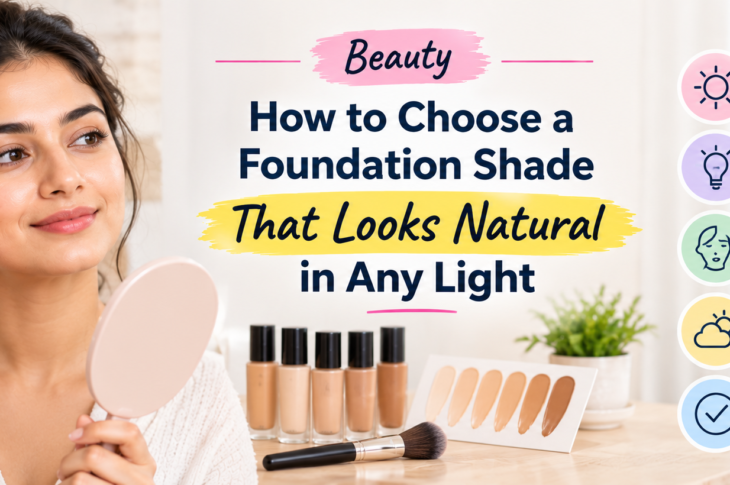
The right foundation should blend into your skin—not sit on top of it. Learn how to find your shade, undertone and finish for a natural-looking base.
Have you ever applied foundation at home, loved the finish, and then noticed something completely different once you stepped outside?
Maybe it looked too yellow in daylight. Or slightly pink under office lights. Sometimes the shade seems perfect in the store but looks noticeably different after a few hours.
Choosing foundation is not simply about finding the closest-looking beige in a bottle.
Your skin tone, undertone, lighting, formula and even the way you apply the product can affect how natural your base looks.
The good news? You do not need to be a makeup expert to make a better shade match.
A few simple checks can help you choose a foundation that looks more seamless in daylight, indoor lighting and photographs.
First, Understand Your Skin Tone and Undertone
Before choosing a foundation shade, understand the difference between skin tone and undertone.
Your skin tone is the visible depth of your skin—such as fair, light, medium, tan or deep.
Your undertone is the subtle color underneath the surface of your skin.
Common undertones include:
- Warm: yellow, golden or peachy
- Cool: pink, red or bluish
- Neutral: a balance of warm and cool tones
- Olive: a subtle greenish or muted golden quality
Your skin tone can change slightly with sun exposure, but your natural undertone generally remains more consistent.
That is why two people with a similar skin depth may need completely different foundation shades.
Don’t Choose a Shade Only by Looking at the Bottle
Foundation packaging can be misleading.
The shade inside the bottle may look different once it is applied to your skin, and artificial store lighting can also change how you perceive the color.
Instead of choosing based only on the label or bottle color, test the actual foundation whenever possible.
And give it a little time before deciding.
Some formulas can change slightly as they dry or interact with the skin.
Test Foundation on Your Jawline
One of the most useful places to test foundation is the jawline, rather than only the back of your hand.
Why?
Your hands may be a different color from your face.
A shade that matches your hand perfectly may still look noticeably different on your face.
Apply a small amount along the jawline and blend it gently toward the neck.
The goal is to find a shade that appears to transition naturally between your face and neck.
Look for this:
If the foundation seems to disappear into the surrounding skin rather than creating an obvious stripe, you may be close to the right match.
Always Check the Shade in Natural Light
Lighting can completely change how foundation looks.
Warm indoor lighting can make some shades appear more golden or flattering than they actually are.
Cool fluorescent lighting can make certain foundations appear different again.
Whenever possible, check your foundation in natural daylight before making your final decision.
Step near a window or go outside briefly and look at the shade without relying on strong artificial lighting.
This is especially useful if you are shopping in a store.
Test More Than One Shade
If you are between two shades, test both rather than immediately choosing one.
Apply narrow stripes of the shades side by side along your jawline.
Then step back and compare them in natural light.
Look for the shade that blends into your skin most naturally.
Avoid judging only by which shade looks brighter or more flattering on its own.
The right foundation shade should not necessarily make your skin look lighter.
Its purpose is to create an even-looking base while allowing your natural skin tone to remain believable.
Pay Attention to Your Undertone
Sometimes the depth of the foundation is correct but something still looks “off.”
That may be an undertone issue.
If your foundation looks too yellow
You may need a more neutral or cooler option, depending on your natural undertone.
If it looks too pink
A warmer or more neutral shade may work better.
If it looks too orange
The formula may be too warm or too deep for your complexion.
If it looks grey or dull
The undertone may not be compatible with your skin, particularly if you have a warm or olive complexion.
These are general clues rather than strict rules. Different brands use different shade systems, so always judge the actual product on your skin.
Your Face and Neck Don’t Always Look Identical
It is common for the face and neck to have slightly different levels of color.
This can happen because of sun exposure, skincare routines and other everyday factors.
That does not mean you need two completely different foundations.
Instead, use the jawline and neck area as a reference when checking whether the shade creates a natural transition.
If the foundation matches your face but creates a visible line at the jaw, it may not be the most seamless choice.
Consider How You Want Your Foundation to Look
Shade is important, but the formula and finish also affect the final appearance.
You may find:
- Matte foundation gives a more shine-controlled finish.
- Natural or satin finishes can look balanced and skin-like.
- Dewy formulas can create a more luminous appearance.
- Lightweight skin tints provide less coverage and allow more of your natural skin to show through.
- Full-coverage formulas can create a more polished look but may require careful application.
Choose based on your skin’s needs and the type of finish you personally prefer.
Think About Your Skin Type
Your ideal foundation shade can still look wrong if the formula does not work well with your skin.
Dry skin
A hydrating or natural-finish formula may feel more comfortable and prevent the base from emphasizing dry areas.
Oily skin
A long-wearing or oil-controlling formula may be preferable, depending on your needs.
Combination skin
You may want a balanced formula and adjust application in different areas.
Sensitive skin
Look for formulas that suit your skin and avoid ingredients you already know cause irritation.
The best foundation is not just the right color. It is also a formula you can comfortably wear.
Don’t Forget About Oxidation
Some foundations may appear slightly different after they have been on the skin for a while.
This can happen because of the formula, your skin’s natural oils and other factors.
If possible, leave the foundation on for a few minutes before making your final decision.
Check it again in natural light.
If the shade has noticeably changed, consider testing another shade or formula.
Take Photos Before You Buy
If you are unsure between shades, taking a quick photo in natural light can sometimes help you compare them more objectively.
You can also look at your face from different angles rather than checking only in a close-up mirror.
Remember that phone cameras and lighting can alter color, so use photos as an additional reference—not the only deciding factor.
Avoid Matching Foundation to Your Hand
This is one of the easiest mistakes to make.
Your hand and face are exposed to different amounts of sunlight and may naturally have different tones.
Instead of testing foundation on the hand, use the jawline or another area recommended by the brand.
This gives you a more relevant reference point.
What About Summer and Winter Shades?
Your skin may change slightly with the seasons.
If you spend more time outdoors during warmer months, your skin tone may become deeper.
During periods with less sun exposure, your complexion may appear lighter.
You may therefore find that one foundation shade does not work equally well throughout the year.
Instead of buying many different products, consider whether a compatible shade-adjusting approach or a second seasonal shade makes sense for you.
A Simple Foundation Shade Checklist
Before buying a foundation, ask yourself:
1. Does the shade match my skin depth?
2. Does the undertone look natural?
3. Have I tested it on my jawline?
4. Have I checked it in natural daylight?
5. Does it still look right after a few minutes?
6. Does the formula suit my skin type?
7. Does the finish match the look I want?
If the answer to most of these is yes, you are much closer to finding a natural-looking foundation.
The Goal Is Skin That Still Looks Like Skin
Foundation does not need to completely transform the color of your face.
A good match should work with your natural complexion.
You should still be able to see dimension in your skin rather than a noticeable mask-like layer.
Remember:
The best foundation shade is often the one people don’t immediately notice.
When the shade, undertone and formula work together, your makeup can look polished while still allowing your natural features to stand out.
And if you get the shade slightly wrong the first time, don’t worry.
Makeup is a process of learning what works for your individual skin.
The next time you shop for foundation, slow down, test it properly, step into natural light and give yourself a few minutes before making the final choice.
A little extra testing can make a big difference to the finished look.
