

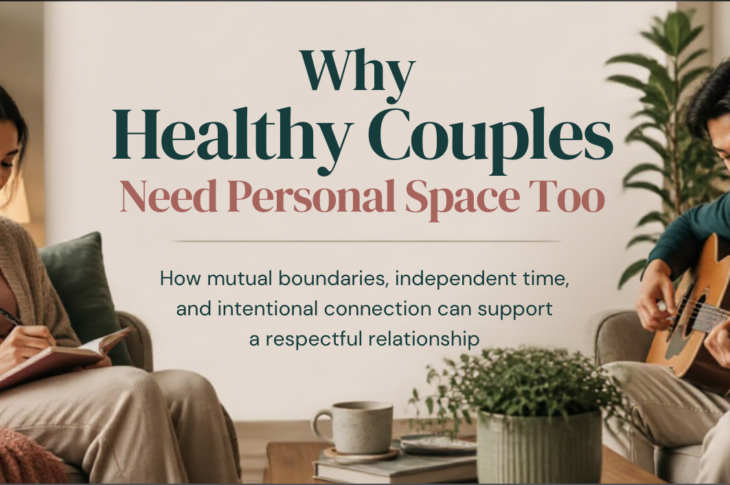
Introduction: Love Does Not Require Constant Access
Two people can care deeply for each other and still feel crowded. Constant messaging, shared routines, family expectations, or the belief that love means doing everything together can quietly turn closeness into pressure. You may adore your partner and still long for an uninterrupted hour, a conversation with a friend, or the freedom to follow your own thoughts.
Personal space is not rejection, secrecy, punishment, or proof that a relationship is failing. In a healthy relationship, it can support rest, identity, focus, friendship, creativity, emotional regulation, and a more intentional connection. The goal is not distance for its own sake. It is enough room for both people to remain whole.
Every couple defines closeness differently. This includes married and dating couples, live-in partners and long-distance couples, queer couples, couples from different cultures, couples with children, caregivers, people in small homes or shared housing, disabled or neurodivergent partners, and people balancing work, study, family, or shift schedules. There is no single correct amount of togetherness.
What Personal Space Means in a Healthy Relationship
Personal space is time, privacy, attention, or physical room that helps a person feel restored and connected to themselves. It might be a quiet hour, a separate hobby, time with friends, privacy around messages or journaling, a solo errand, an independent goal, a different sleep or work routine, or permission not to respond immediately.
- Space can be small. A few quiet minutes may matter when someone is caring for children, working a shift, sharing a room, or living with limited privacy.
- Space can be social. A friendship, community, family connection, or support group can strengthen identity outside the partnership.
- Space can be focused. Time for study, work, art, exercise, faith, rest, or a personal project is not time stolen from love.
- Space can be private. A journal, personal conversation, or quiet inner life does not automatically represent secrecy.
Why Closeness and Independence Can Coexist
Closeness and independence are not opposite ends of a relationship. A couple can share affection, plans, values, finances, parenting, or a home while each person maintains meaningful parts of life that belong to them. Independence creates choice: time together becomes something both people participate in, not something either person must provide every minute to prove devotion.
This balance may look different across cultures, households, disabilities, energy levels, and relationship structures. One partner may recharge alone while the other prefers gentle conversation. The work is not to make those needs identical. It is to make them understandable, respectful, and workable for both people.
|
Key idea: Personal space is healthiest when it is negotiated with care. It should support rest and identity without being used to avoid accountability, create uncertainty, or make a partner earn basic reassurance. |
The Difference Between Healthy Space and Emotional Withdrawal
Healthy space is clear, respectful, and compatible with care and agreed responsibilities. When necessary, it has a time frame or a clear point of reconnection. Someone might say they need an hour after work, a quiet afternoon, or a night to sleep before discussing a tense subject. They are not required to offer a perfect explanation, but they do communicate enough to avoid leaving the other person constantly guessing.
Emotional withdrawal can look different. It may involve refusing all communication, using silence to control, repeatedly cancelling agreed plans without explanation, hiding important information, or avoiding every difficult conversation. Look at patterns rather than judging one isolated moment. A person may be overwhelmed, ill, grieving, or overstimulated on a particular day; the wider pattern and the willingness to repair matter.
Signs a Couple May Need More Breathing Room
Without diagnosing anyone, these signs can suggest that a couple needs to examine how much contact, responsibility, and recovery time each person has:
- Irritability over small things or feeling overstimulated by constant contact
- Losing touch with friends, hobbies, rest, or personal goals
- Feeling responsible for a partner’s every emotion or availability
- Resentment because all free time has quietly become shared time
- Difficulty concentrating on work, study, parenting, or caregiving
- Anxiety when a message is not answered immediately
- Arguments that seem to arise from exhaustion rather than the actual issue
- Feeling guilty for wanting alone time
These signs can also come from stress, burnout, depression, anxiety, conflict, unsafe dynamics, or practical overload. Personal space is not a universal solution, and it should not be used to minimize serious distress or relationship harm.
Benefits of Personal Space for Individuals and the Relationship
Thoughtful space can give someone time to recover and regulate after work, social demands, illness, or caregiving. It can preserve individual identity and meaningful friendships, improve focus on learning or creative goals, and reduce resentment caused by unspoken expectations. It may also lead to more interesting conversations and renewed appreciation because each person has experiences to bring back into the relationship.
Space can make affection more deliberate rather than automatic. It can clarify consent, choice, and mutual respect: you are together because you want to be, not because neither person is allowed a life beyond the partnership. That does not mean space will fix a relationship, prevent a breakup, or guarantee lasting happiness. It simply creates conditions in which honest needs may be easier to notice and discuss.
How to Ask for Space Without Making a Partner Feel Rejected
An effective request names the need, gives an approximate time or context, offers appropriate reassurance, and identifies any shared responsibility that still needs attention. Reassurance should be honest and realistic, not a promise you cannot keep.
- Try: “I love you, and I need a quiet hour after work before we talk about the evening.”
- Try: “This is about restoring my energy, not pulling away from you.”
- Try: “Could we keep Saturday afternoon for our separate plans and meet for dinner?”
- Try: “I may not reply immediately while I am focusing, but I will check in later.”
- Try: “I want us to decide together what feels reassuring and realistic.”
Avoid presenting space as a threat, test, or vague punishment. A request is more caring when it explains what would help without blaming the other person for having needs of their own.
How to Create Practical Agreements Around Space
Good agreements are specific enough to reduce anxiety but flexible enough to survive real life. Discuss what alone time looks like for each person, then decide how communication and shared responsibilities will work around it.
|
Area |
Helpful agreement |
|
Time |
Protect realistic periods for rest, hobbies, friendships, appointments, and personal goals. |
|
Communication |
Agree on check-ins that offer reassurance without becoming surveillance. |
|
Responsibilities |
Share household, parenting, financial, and caregiving work fairly before either person takes time away. |
|
Privacy |
Clarify expectations around phones, passwords, diaries, social media, and personal conversations. |
|
Flexibility |
Revisit the plan when jobs, health, family, housing, or schedules change. |
Trust does not require unlimited access to every private thought, device, or conversation. Privacy and honesty can coexist, but agreements should be mutual rather than secretly applied by one person. One partner’s “space” should not simply transfer invisible work to the other.
Personal Space When Living Together
Even in a small home or shared housing, couples can create modest zones and time blocks. Headphones, a closed door, a visual signal, separate errands, or alternating quiet periods may help when those options are available. Neither partner should treat shared space as one person’s territory.
Build individual routines around mornings, meals, exercise, hobbies, or bedtime without making connection disappear. If privacy is limited because of children, roommates, disability, illness, or finances, communicate the constraint rather than blaming either partner. A five-minute reset, a solo walk, or sitting quietly in the same room may be a realistic version of space.
Personal Space in Long-Distance and Busy Relationships
Long-distance and busy couples may assume that constant calls or messages are the only proof of connection. In reality, personal space can include not being available for continuous video calls, keeping independent friendships, or following a routine without providing a live report of every hour.
Set communication windows that fit real schedules and time zones. Planned connection can create reliability, while flexibility leaves room for work, health, family needs, shift changes, and unexpected fatigue. Share meaningful updates without turning every delay into a relationship referendum. The aim is dependable care, not constant monitoring.
Balancing Independence With Emotional Availability
Independence does not mean emotional isolation. A person can take an afternoon alone and still be available for an important conversation, a child’s need, a medical concern, or an agreed responsibility. Before stepping away, ask: Is there anything urgent we need to handle? What time or signal will help us reconnect? What support can I realistically offer?
Likewise, being emotionally available does not mean answering every message instantly or absorbing every feeling without limits. Partners can listen, express care, and encourage wider support while still acknowledging their own capacity. If persistent conflict, disconnection, anxiety, or distress continues, a qualified couples counsellor or mental-health professional may help when safe and accessible.
Boundaries, Trust, and Digital Privacy
No one owes constant access to their body, phone, location, finances, or private conversations. Healthy space includes consent, respect, honesty, and the ability to say no without retaliation. A request for space should never be used to control, isolate, punish, threaten, monitor, or deceive a partner.
If a partner responds to ordinary boundaries with threats, intimidation, stalking, coercive control, violence, or financial restriction, the issue is not simply a communication gap. Consider contacting a trusted person, qualified local professional, or domestic-violence service. Do not confront an unsafe partner alone. Support and safety planning should fit the person’s circumstances.
Common Mistakes to Avoid
- Using “I need space” as a vague punishment or threat
- Disappearing without communicating when a check-in is reasonably expected
- Treating every independent activity as suspicious
- Keeping score of who gets more time alone
- Calling normal privacy secrecy without an agreed reason
- Using personal space to avoid every repair conversation
- Expecting one partner to manage all household or emotional work while the other “recharges”
- Comparing the relationship with couples online
- Assuming one partner’s preferred amount of closeness is the universal standard
- Trying to solve deeper disrespect, manipulation, or safety issues with a weekend apart
A Realistic 7-Day Personal-Space Reset
Treat this as an optional experiment, not a prescription. Adapt it for children, disability, illness, shift work, long distance, limited space, religious commitments, financial constraints, or any other reality that shapes your time.
- Day 1: Each person privately notes what helps them feel restored and what makes them feel crowded.
- Day 2: Share one small need without blaming or defending.
- Day 3: Schedule a short individual activity for each person.
- Day 4: Agree on a practical communication expectation during that time.
- Day 5: Share one household or caregiving responsibility more clearly.
- Day 6: Have intentional connection without phones or multitasking.
- Day 7: Review what felt supportive, what felt uncomfortable, and what needs changing.
Five Small Actions to Start This Week
- Name one activity that helps you recharge.
- Ask your partner what helps them feel restored.
- Make one small, time-specific space agreement.
- Protect one friendship, hobby, rest period, or personal goal.
- Plan one intentional connection moment that is not about logistics.
